About Cerioporus squamosus (Huds.) Quél.
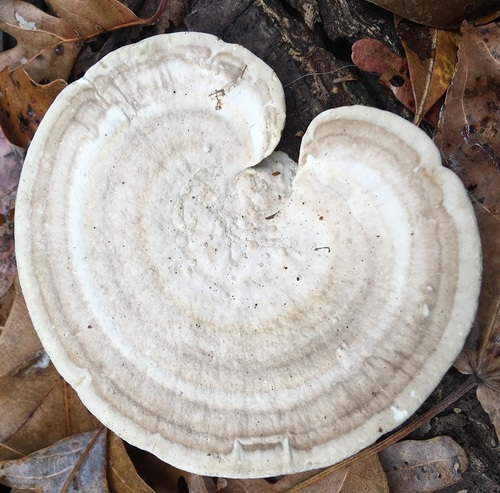
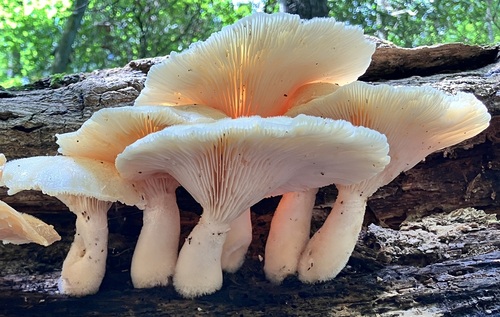
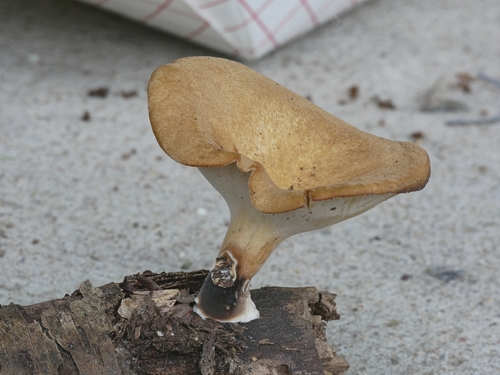
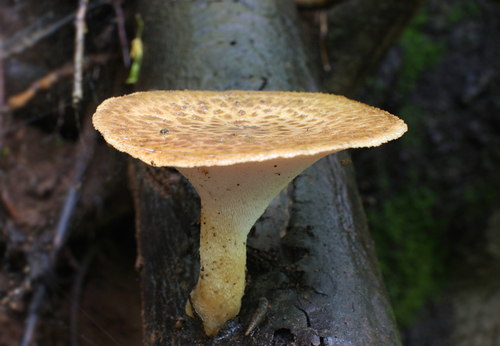
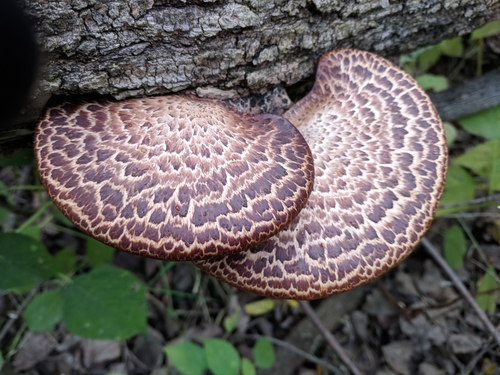
Scientific name: Cerioporus squamosus (Huds.) Quél. Dryad's saddle is an annual mushroom. It is commonly found attached at one point to dead logs, stumps, or living hardwood trees via a thick stem. Its round fruit body typically measures 8–30 centimetres (3–12 inches) across, reaching an exceptional maximum of 60 cm (24 in), and grows up to 10 cm (4 in) thick. The upper surface of the fruit body ranges from yellow to brown, and is covered in squamules, or scales. The underside bears pores characteristic of the genus Cerioporus, formed from tightly packed tubes. These tubes are 1 to 12 mm (1⁄16 to 1⁄2 in) long. The stalk is 3–12 cm (1–4+1⁄2 in) long and 1.5–3.5 cm (1⁄2–1+1⁄2 in) thick. This mushroom has a scent similar to watermelon rind. Its fruit body produces a white spore print. Spores are 11–15 x 4–5 μm, with a shape of long, smooth ellipsoids. Fruit bodies can grow alone, in clusters of two or three individuals, or form shelves. Young specimens are soft, but toughen as they age. This species is especially common on dead elm, and also grows on living maple trees. Fruit bodies can grow very quickly. One specimen studied by pioneer botanist Sir William J. Hooker in Dalbeth, Scotland in 1810 grew to a circumference of 2.3 m (7 ft 7 in) and a weight of 15.5 kg (34 lb) over four weeks. This species is common, widespread, and found across much of Europe (fruiting from July to November) and east of the Rocky Mountains in the United States (fruiting from April to October). It also occurs in Asia and Australia. It most commonly fruits in spring, fruits occasionally in autumn, and rarely fruits during other seasons. Many mushroom foragers encounter this large mushroom when searching for morels in spring, as the two species fruit at the same time. As a white rot fungus, it plays an important role in woodland ecosystems by decomposing wood, most often elm or maple, and occasionally acts as a parasite on living trees. Other known tree hosts include ash, beech, horse-chestnut, Persian walnut, lime, plane, poplar, magnolia, and willow. This species is edible when young and cooked. As specimens mature, they may become infested with maggots, develop a firm, rubbery texture, and become inedible. Preparation guides generally recommend harvesting young mushrooms, slicing them into small pieces, and cooking them over low heat. Some people use Cerioporus squamosus, along with many other species in the genus Cerioporus, to make thick, stiff paper.