About Cereus jamacaru DC.
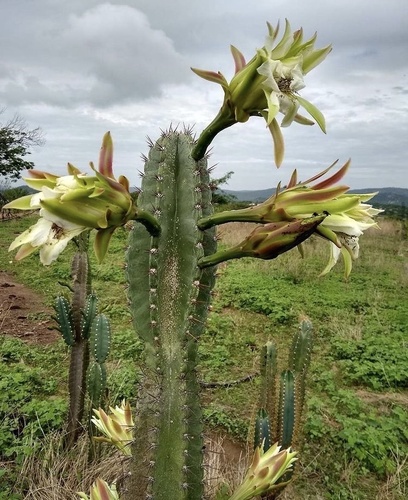
Cereus jamacaru DC. is a succulent tree species with a woody stem. Mature plants reach around 9 meters in height, and can grow up to 15 meters tall, forming large crowns with segmented stems. Trunks can grow to 45 centimeters in diameter, with 4 to 6 slightly wavy notches; older trunks develop more notches. Segmented twigs typically have four to six ribs that measure 8 to 20 centimeters long, and 5 to 7 radial structures 1.5 centimeters long; aged plants may develop up to ten ribs as existing ribs become compressed over time. New ribs are around 3.5 centimeters high, and grow taller as the plant ages. Yellow to brown areoles are spaced 2 to 4 centimeters apart along the ribs. Each areole bears 15 to 20 yellowish to brownish spines, split into 7 to 9 radial spines and 6 to 13 central spines. The full total number of spines often develops gradually over many years. Spines that grow later are particularly tough, and reach up to 10 centimeters long, rarely growing as long as 20 centimeters. The species produces white night-opening flowers that are around 30 centimeters (10 inches) long. The outer surface of the petals is green and white with a brown outer edge; outer bracts are brownish to light green, while inner bracts are white. Flower buds usually emerge in mid-spring, and each individual flower only lasts for one night: it opens at dusk and wilts by the following morning. After fertilization, the plant produces egg- to pear-shaped fruits that measure around 6 centimeters in diameter and 12 centimeters long. Ripe fruits turn carmine to coral red and split open lengthwise. The fruit has a very strong violet outer color, with white pulp containing tiny black seeds that are approximately 3 millimeters in size. The fruit pulp is considered very tasty. This species is endemic to the Brazilian states of Alagoas, Bahia, Ceará, Goiás, Maranhão, Minas Gerais, Paraíba, Pernambuco, Piauí and Rio Grande do Norte. It is very common in semi-arid caatinga habitats. Many native bird species, including the white-naped jay (known locally as gralha-cancã) and the Caatinga parakeet (known locally as periquito-da-caatinga), feed on its fruits. A thornless cultivar of the species is used for animal feed. The common thorny type is also used for animal feed after thorns are removed by burning or cutting. Cereus jamacaru, commonly called mandacaru, is highly drought-resistant. It appears on the flag of the city of Petrolina, located in the state of Pernambuco, Brazil.