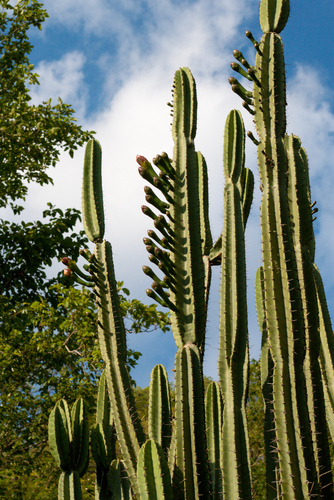
About Cereus hankeanus F.A.C.Weber ex K.Schum.
Cereus hankeanus (synonym Cereus forbesii) is a columnar, branching, colony-forming cactus. It can grow up to 3 m (9 ft 10 in) in height, with a mature circumference of around 15 cm (5.9 in). Growth-limiting factors including weather, natural breakage, and self-propagation mean it is more commonly observed at around 2 m (6 ft 7 in) tall. Larger recorded specimens can exceed 7 m (23 ft) in height. Its cylindrical glaucous shoots are blue-green when young, turning light green as they mature, and have a diameter of 5 to 8 centimeters. The cactus columns have 4 to 8 blunt, compressed ribs. Small gray areoles form on the ribs. Most individuals grow a single strong, yellowish-brown central spine up to 16 centimetres (6.3 inches) long, though some develop two or three central spines. Five surrounding radial spines grow to a maximum length of 2 centimetres (0.79 inches). Flowers range in color from white to reddish, and often have pink outer petals and a yellow center. After pollination, blooms ripen into red, pulpy fruits similar to those of some Opuntia species. This cactus is endemic to the Argentine provinces of Catamarca, Chaco, Córdoba, Formosa, Jujuy, La Rioja, Salta, Santa Fe, Santiago del Estero, Tucumán, and the area north of the city of San Luís. In Bolivia, it occurs in the departments of Chuquisaca, Santa Cruz and Tarija. It grows on arid, windswept hills, in sparse forests, on wooded plains, and along the edges of salt flats, most commonly at elevations between 500–2,000 m (1,600–6,600 ft). Like its close relatives, it has adapted to extreme temperature fluctuations, including full sun exposure during the day and seasonal near-freezing night temperatures, especially in winter. Plants growing above 2,000 m above sea level may also experience winter snowfall.