About Cercyonis pegala Fabricius, 1775
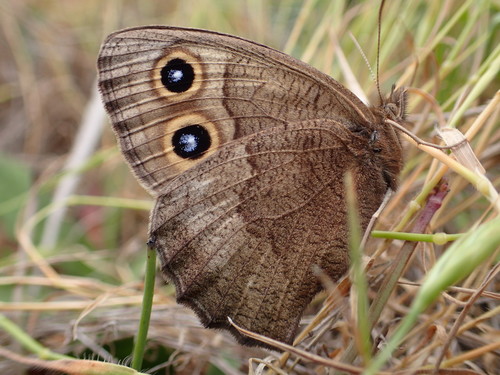
Cercyonis pegala, commonly known as the common wood-nymph, exhibits significant variation across individuals. All common wood-nymph butterflies are brown, with two eyespots on each forewing, and the lower eyespot is often larger than the upper one. The ventral surface of the hindwing may have many eyespots, few eyespots, no eyespots, depending on the individual. In the southeastern portion of its range, the species has a large yellow patch on both surfaces of the forewing. In the western portion of its range, it may have a pale yellow patch or no patch at all. Individuals in the Northeast, including the subspecies C. p. nephele, also lack this yellow patch. In individuals without a yellow patch, two pale yellow eye rings encircle both of the forewing eyespots. The wingspan of the common wood-nymph ranges from 5.3 to 7.3 cm (2.1 to 2.9 in). These butterflies have ears located at the bases of their forewings, which are most sensitive to low-frequency sounds below 5 kHz. A noticeable swelling on the forewing subcostal vein is directly connected to these ears. The common wood-nymph's distribution extends from Nova Scotia and Quebec west to northern British Columbia, south to northern California, southeast to Texas, and east to northern Florida. It occupies a wide range of open habitats, including open woodlands, woodland edges, fields, pastures, wet meadows, prairies, salt marshes, and savannas. Among common wood-nymphs, the female is the active flight partner. Females lay their eggs on or near the host plant. Eggs are initially pale yellow, and later turn tan with orange or pink blotches. Caterpillars do not build shelters or nests. Their bodies are green or yellowish-green with darker green stripes running lengthwise along the body. They have two short pinkish projections at the end of the abdomen, yellow spiracles, and are covered in thin white hairs. Full-grown caterpillars reach a length of 5 cm (2 in). The common wood-nymph caterpillar is very similar to satyr caterpillars from the genera Hermeuptychia, Cyllopsis, and Neonympha, but can be distinguished by its larger size and different habitat. The chrysalis is pale green with white or pale yellow stripes. First instar caterpillars hibernate over winter. Adult common wood-nymphs feed on nectar, tree sap, and decaying organic matter. They commonly nectar from a range of plant species, including Asclepias tuberosa (butterfly weed), Cirsium arvense (Canada thistle), Cirsium vulgare (bull thistle), Daucus carota (wild carrot), Dipsacus sylvestris (teasel), Monarda fistulosa (wild bergamot), Pycnanthemum virginianum (Virginia mountain mint), Rudbeckia hirta (black-eyed susan), Trifolium pratense (red clover), and Vernonia gigantea (tall ironweed).