About Cerbera floribunda K.Schum.
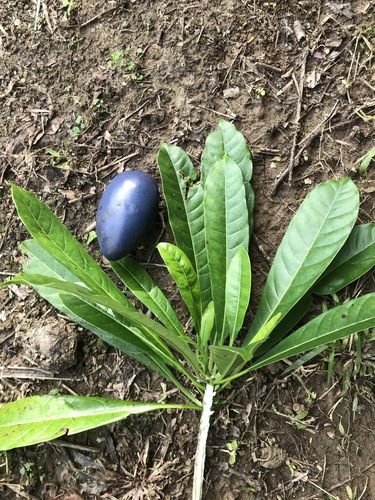
Cerbera floribunda K.Schum. is a tree that can grow up to 30 m (98 ft) tall. Its bark ranges in color from brown to grey or black, and both its sapwood and heartwood are white. The leaves are lanceolate-elliptic in shape; they are glossy green on the upper surface, paler on the lower surface, arranged alternately or in whorls, and crowded near the ends of twigs. Leaves can reach up to 30 cm (12 in) long and 5 cm (2 in) wide, have 13 to 20 curved lateral veins, and are attached to twigs by a long petiole that grows up to 40 mm (1.6 in) long.
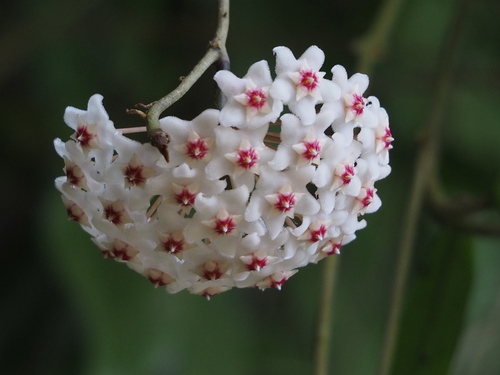
The inflorescence of this species is a much-branched cyme that reaches up to 17 cm (6.7 in) in size, and usually holds more than 50 flowers. Each flower has 5 white sepals, a corolla tube that measures up to 12 mm (0.47 in) long by 3 mm (0.12 in) wide, with 5 free lobes at the end of the tube. The flowers are white with a pink or red center, have a diameter of around 25 to 30 mm (1.0 to 1.2 in), and carry a sweet scent.
The fruit is a bright blue or purple drupe, measuring about 10 cm (4 in) long by 5 cm (2 in) wide. It is slightly pointed at the end opposite the pedicel (stem), and contains a single large seed.
This is a tropical plant that prefers conditions with abundant water. Its native range extends from Sulawesi, east through the Maluku Islands and New Guinea to the Solomon Islands, and south to Queensland, Australia. It is widespread across this entire native range, and is not considered endangered. It generally grows along creeks and in marshes, and is always found near permanent water. In Australia, it grows at altitudes from sea level up to 500 m (1,600 ft).
Southern cassowaries swallow the whole fruits of Cerbera floribunda, and are not affected by the plant's toxins. The birds later excrete the seeds, which helps distribute the plant. Because of the large size of the fruits, the southern cassowary is the only animal that can carry out this seed dispersal, making this a classic example of a symbiotic relationship between the two species. Rodents, most notably the giant white-tailed rat, eat the seed kernels after stripping away the fruit flesh; if they leave part of the kernel behind, the remaining seed is unlikely to germinate.
Like other Cerbera species, and many other species in the plant family Apocynaceae, the fruits of this plant are toxic to humans. Cerbera species contain the cardiac glycoside cerberin; eating any part of the fruit can cause nausea, vomiting, abdominal pain, and potentially death. The white sap produced by all parts of the tree may also cause skin irritation if it touches the skin.
The timber of Cerbera floribunda has been used for mouldings and interior finishings in Bougainville and other parts of Papua New Guinea, and for carvings and traditional medicine in the Solomon Islands.