About Cerastium glomeratum Thuill.
Growth Form
Cerastium glomeratum Thuill. is an annual herb that grows from a slender taproot.
Stem Characteristics
It produces a branched stem up to 45 centimeters tall, covered in abundant glandular and non-glandular hairs.
Leaf Morphology
Its leaves are opposite, hairy, and grow up to 2 cm long; basal leaves typically die back before flowering begins.
Bract Characteristics
Bracts are green, hairy, and generally similar in appearance to the plant’s leaves.
Inflorescence Structure
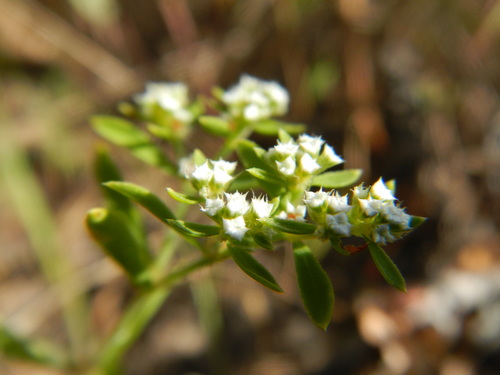
The inflorescence holds between 3 and 50 small dioecious flowers arranged in a cyme, each attached to a very short pedicel.
Flower Parts
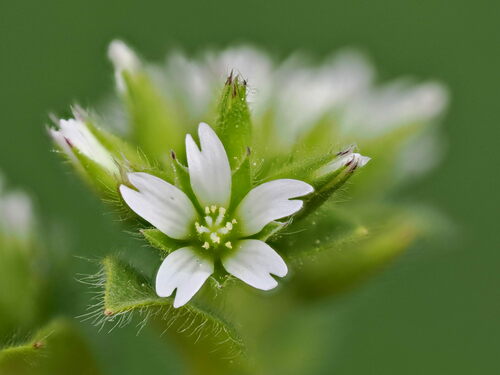
Each flower has 5 hairy green sepals, which are occasionally tipped red, and 5 white bifid petals that are a few millimeters long and generally match the length of the sepals.
Fruit Morphology
The fruit is a capsule less than one centimeter long, tipped with ten tiny teeth.
Identification Features
For identification, this plant usually has abundant glandular hairs on the upper stem and on the sepals. As an annual species, whole plants are easily uprooted, and every stem produces flowers.
Flower Cluster Traits
Flowers grow on very short pedicels, so flower clusters tend to be tightly packed.
Habitat
This species is frequent in waste places, walls, banks, and arable land.
Historical Food Use
Historically, its leaves and shoots were used as a wild food in ancient China.
Medicinal Uses
In Nepal, the plant’s juice is applied to the forehead to relieve headaches, and can also be dropped into the nostrils to treat nosebleeds.
Food Preparation
Its leaves can be boiled before eating.