About Cerambycidae
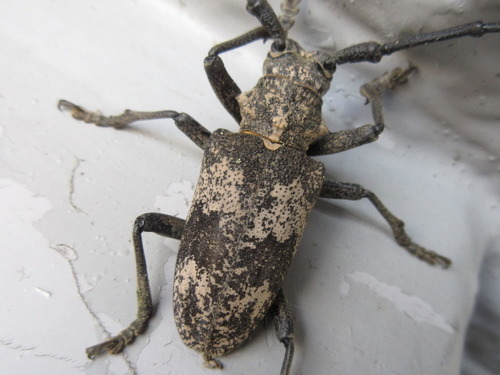
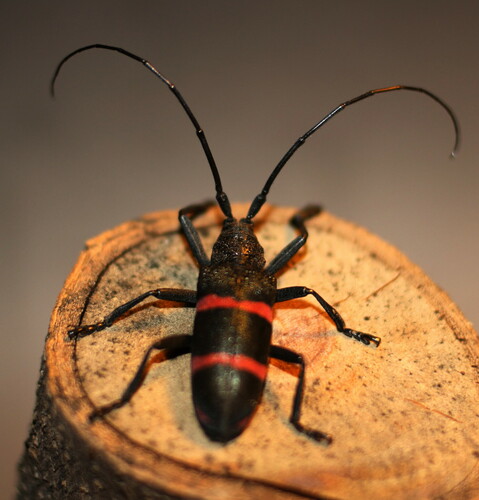
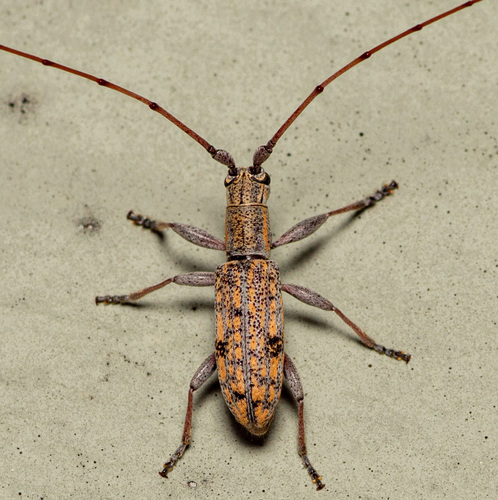
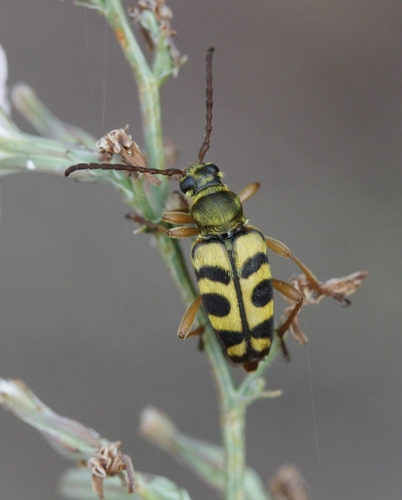
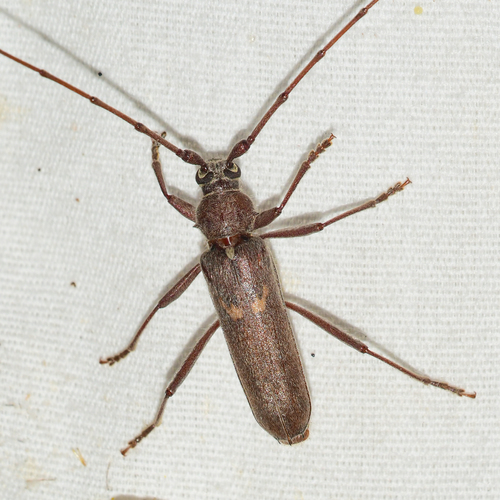
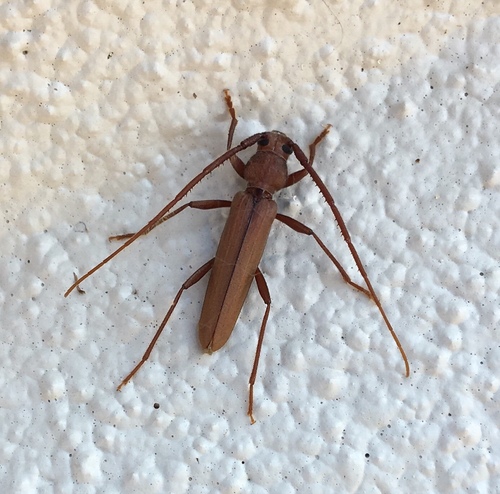
Cerambycidae is the longhorn beetle family. For adult longhorn beetles, the most consistently distinct trait, besides the typical long antenna length, is that their antennal sockets sit on low tubercles on the face. Other beetles with long antennae do not have these tubercles, and even longhorn beetles with short antennae still retain this feature. Beyond this trait, members of the family vary widely in size, shape, surface sculpture, and coloration. Several species mimic ants, bees, and wasps, while most species have cryptic coloration that helps them blend into their surroundings. The titan beetle (Titanus giganteus) from northeastern South America is often considered the largest insect (though not the heaviest, and not the longest when legs are included), with a maximum recorded body length just over 16.7 cm (6.6 in).
Longhorn beetle larvae range from 0.5–22 cm (0.20–8.66 in) long, have an elongated body shape, and are lightly sclerotised. Their prothorax is often enlarged, and their body sides have lateral swellings called ampullae. The head is usually retracted into the prothorax and carries well-sclerotised mouthparts. Larval legs can range from moderately developed to completely absent, and their spiracles are always annular in shape.
Some longhorn beetle species feed on pollen or nectar in addition to other plant tissues, and may act as pollinators. It is difficult to measure how effective longhorn beetles are as pollinators. Even when a beetle is confirmed to pollinate one plant species, it may act as a flower predator for other plant species. In some cases, the same beetles can act as both pollinators and predators on the same flowers. Flowers that are specialized for beetle pollination usually have a distinct set of traits, but pollination by longhorn beetles is not restricted to these cantharophilous flowers.
A review of angiosperm pollination by beetles found that Cerambycidae, along with Curculionidae and Scarabaeidae, includes many taxa that act as pollinators in both specialist and generalist pollination systems. New Zealand longhorn beetles in the genus Zorion feed on pollen and have a specialized structure similar to the pollen baskets found on bees. Species in this genus are thought to be important pollinators for native New Zealand plants such as harakeke. Some orchid species are largely dependent on longhorn beetles for pollination. In Poland, the longhorn beetle species Alosterna tabacicolor was found to be the main pollinator of the rare orchid Dactylorhiza fuchsii. Another rare orchid, Disa forficaria native to the Cape Floristic Region of South Africa, relies on the longhorn beetle Chorothyse hessei for pollination. D. forficaria uses sexual deception to attract male C. hessei, which may point to a long history of co-evolution between this orchid and its longhorn beetle pollinator. The proportion of longhorn beetle species that act as pollinators remains unknown. The fact that two longhorn beetle species from separate subfamilies (Lepturinae and Cerambycinae) found on different continents both hold meaningful roles as pollinators could suggest that some capacity for pollination is common across longhorn beetles.