About Cephalopachus bancanus (Horsfield, 1821)
Scientific Name
Cephalopachus bancanus (Horsfield, 1821).
Physical description
Color and Size
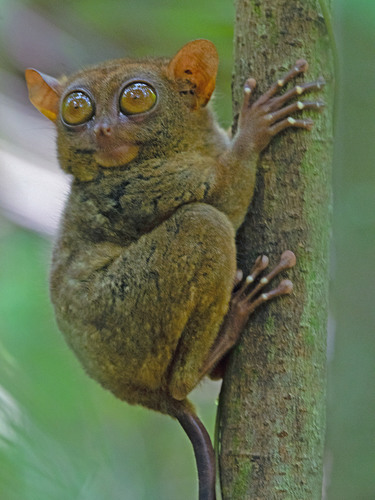
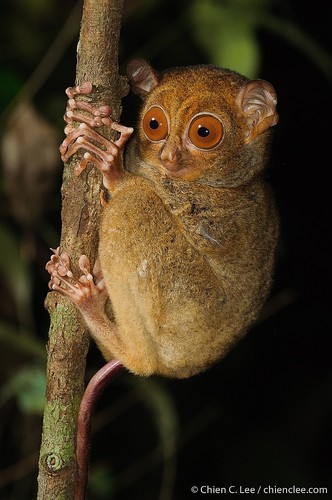
The fur (pelage) color of this species ranges from pale-olive or reddish brown to pale or dark grey-brown, and this variation may be linked to age. Measurements from 12 collected specimens show a head-to-body length range of 121–154 mm (4.8–6.1 in).
Tail and Feet
Horsfield's tarsier has an extremely long tail that measures 181 to 224 mm (7.1 to 8.8 in); the tail is hairless except for a tuft of hair at its tip. Each foot of this species has two grooming claws. The fingers are very long and have pads at their tips. The toes have flattened nails, except for the second and third toes on the hind feet, which bear claw-like nails.
Eyes and Teeth
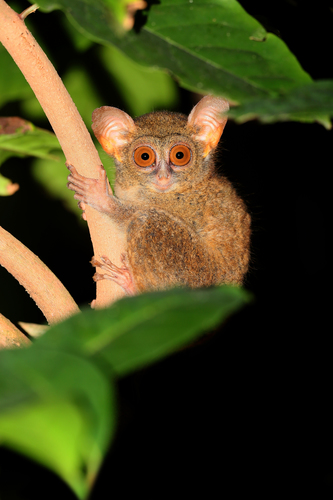
It has large eyes that do not reflect light. Its membranous ears are slender and almost hairless. The molars of this species have high cusps and are almost tritubercular. The dental formula is 2:1:3:3 for the upper jaw, and 1:1:3:3 for the lower jaw.
Habitat and distribution
Range
Horsfield's tarsier is found in Southern Sumatra, Borneo, and nearby islands.
Bornean Records
The Bornean subspecies, C. b. borneanus, is recorded from many lowland sites in Sabah, Brunei, Sarawak, and West Kalimantan, and also occurs above 900 m (3,000 ft) in the Kelabit uplands of northern Sarawak. Additional records document this subspecies from Kutai and Peleben in East Kalimantan, and Tanjung Maruwe in Central Kalimantan.
Forest Habitat
This species can inhabit both primary and secondary forests, and also lives in coastal forests and forests along the edges of plantations.
Life Cycle
Mating Behavior
Horsfield's tarsiers are monogamous, and copulation occurs once per night while females are in estrus. Males produce courtship calls, emitting 2–3 chirrups while opening and closing the mouth. This call is made within 5 minutes of a male observing a female. If the female is receptive after the male's courtship call, she performs genital displays toward him. If the female is not in estrus, she emits an agonistic call, which is often followed by biting and pushing the male away.
Calls and Infants
On average, calls from both sexes last 1 second, and the average interval between calls is 3 seconds. Infants are born with their eyes open, fully furred, and able to groom themselves. The mother carries her infant in her mouth, and parks the infant on a branch while she forages for food. Infant vocalizations are mostly clicks: sounds like "k", "tk", "ki", or a rapid "kooih", which are heard when the infant is left alone or cold. The mother stays in contact with her infant using high-pitched calls.
Grooming and Territory
Infants first use their tails for support during resting at 7–10 days old. Social grooming in this species only takes place between mothers and infants. Individuals remove dead skin and parasites by scratching with their toe claws and licking fur, avoiding the face. Faces are cleaned by rubbing them on branches, and social grooming also functions to reinforce social bonds. Young tarsiers leave their mother's range when they reach puberty and establish their own territory. Horsfield's tarsiers mark their territory with scents from urine and glandular secretions, which they deposit on a surface while scratching the surface with the toe claws on their hind limbs.