About Cephalanthus occidentalis L.
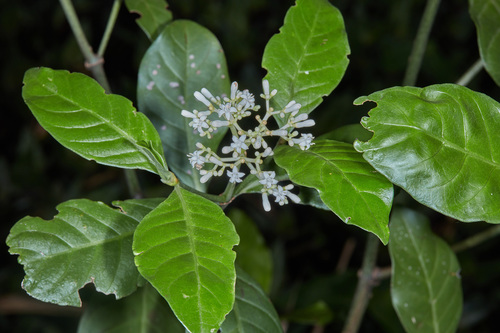
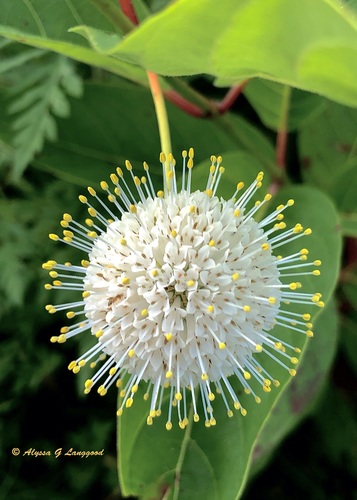
Cephalanthus occidentalis L., commonly called buttonbush, is a deciduous shrub or small tree. It usually grows 1 to 3 meters (3.3 to 9.8 feet) tall, though it can reach up to 6 meters (20 feet) in height. Its leaves grow opposite each other, or in whorls of three. They are elliptic to ovate in shape, 7 to 18 centimeters (2.8 to 7.1 inches) long and 4 to 10 centimeters (1.6 to 3.9 inches) broad, with smooth edges and short petioles. Its flowers grow in dense spherical inflorescences 2 to 3.5 centimeters (0.79 to 1.38 inches) in diameter, borne on short peduncles. Each individual flower has a fused four-lobed corolla, colored white to pale yellow, that forms a long slender tube connecting to the sepals. The stigma extends slightly out from the corolla. When mature, the plant produces a spherical cluster of achenes, or nutlets, as fruit. Buttonbush is a common shrub that grows in a wide range of wetland habitats across its native range. These habitats include swamps, floodplains, mangroves, pocosins, riparian zones, and moist forest understories. It is a documented component of the native flora of the Everglades. This species is native primarily to eastern North America, with separated disjunct populations present in western parts of the continent. In Canada, its range extends from southern Ontario and Quebec east to New Brunswick and southwestern Nova Scotia. In the United States, it is widespread across the eastern states and eastern regions of the Midwest. Notable western populations extend into Arizona, including the Mogollon Rim and other Arizona mountain ranges, and across the entire San Joaquin Valley of California. West of the Great Plains and Rocky Mountains, C. occidentalis is only found in western Texas, Arizona, and California. In its ecosystem, waterfowl and other birds eat the seeds of C. occidentalis. Wood ducks use the plant for nest protection, while mallards consume its fruit. Deer browse the plant’s foliage, and the foliage is known to be poisonous to livestock. Nectar from the flowers is consumed by insects and hummingbirds, and bees use this nectar to make honey. C. occidentalis also acts as a larval host plant for three moth species: the hydrangea sphinx, royal walnut moth, and titan sphinx. Cephalanthus occidentalis has a number of recorded historical medicinal uses, but it is also toxic, due to the presence of the compound cephalanthin. In cultivation, buttonbush is grown as an ornamental plant. It is planted in gardens and native plant landscapes for its aesthetics, to provide a nectar source, and to serve as a honey plant. It is also planted on slopes to help control erosion, and it is considered a suitable shrub for butterfly gardens.