About Cephalanthera rubra (L.) Rich.
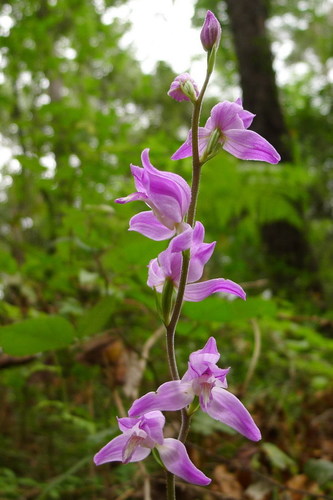
Each flowering shoot of Cephalanthera rubra (red helleborine) reaches 20 to 70 cm in height. Shoots grow from a creeping rhizome. The stem is smooth at the base, and densely covered with short glandular hairs in its upper portion. Each shoot holds between 2 and 8 lanceolate leaves, which measure 5 to 14 cm long and 1 to 3 cm wide. Each shoot can bear up to 20 flowers, which are most often pink to red, and very rarely white. Open flowers reach up to 5 cm wide. Petals are curved and lanceolate. Flowering occurs from May to July. This species can sometimes go many years without producing flowers. Its chromosome count is 2n=36. It should not be confused with Epipactis atrorubens, or dark red helleborine.
Red helleborine is distributed across most of Europe, extending east to the Urals and reaching as far north as 60 degrees latitude. It is rare in Britain, the Low Countries, and western France. It also grows in Morocco, Algeria, and Tunisia, and across parts of southern Asia as far east as Iran. It inhabits light, dry forest, most commonly growing among beech trees, pines, and spruces. It can grow at altitudes up to 2,600 m (8,500 ft), and it occurs most often on calcareous soils with a pH between 5.9 and 8.2. Flower colour correlates with soil properties: darker blooms grow on ground that is more calcareous. Red helleborine is very rare in Britain, where it is currently found only at three sites: Workmans Wood in Sheepscombe, Gloucestershire; Hawkley Warren in Hampshire, where it was first discovered in 1986; and Windsor Hill SSSI, a woodland just east of Princes Risborough in the Chilterns, Buckinghamshire. During the 19th and early 20th centuries, the species was recorded from single sites in Somerset, Sussex, and Kent, as well as a second site in Hampshire in the upper Test Valley. It was also recorded at other sites in Gloucestershire, including Stanley Wood in King's Stanley, now a Woodland Trust woodland, and persisted at some of these sites into the 1970s. It became a protected species in the UK in 1975 under the Conservation of Wild Creatures and Wild Plants Act.
Ecologically, Cephalanthera rubra is thought to be mainly pollinated by flies, though self-pollination is often triggered by rainfall. Pollination can also be done by the bee Chelostoma (likely Chelostoma campanularum) and the weevil Miarus campanulae; both insects are believed to mistake C. rubra flowers for Campanula persicifolia, a mountain wildflower native to continental Europe. It is theorized that C. rubra mimics C. persicifolia to increase pollination early in the growing season. Because flowers of this orchid are frequently visited by flies, crab spiders have been observed hunting in the flowers. C. rubra forms a mycorrhizal relationship with fungal species in the genera Leptodontidium, Phialophora, and Tomentella. This relationship allows the orchid to access soil nutrients that it could not take up on its own.