About Cephalanthera damasonium (Mill.) Druce
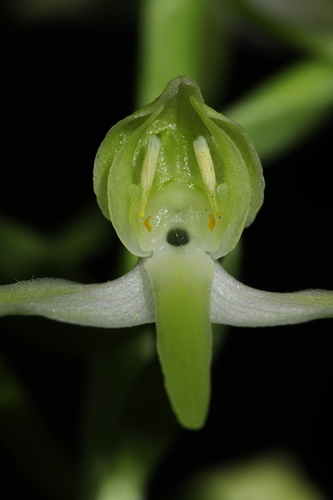
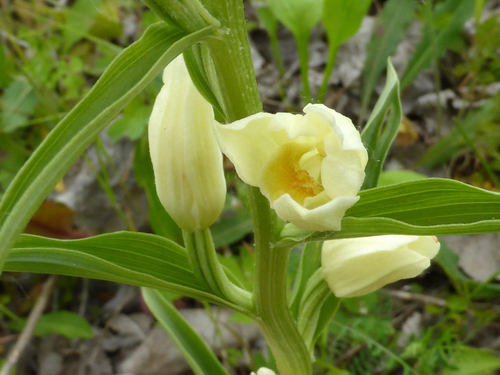
Cephalanthera damasonium is a herbaceous perennial orchid that reaches a maximum height of about 60 cm. Its leaves are ovate, growing narrower further up the stem, and have parallel venation. It produces white flowers that never fully open, and each single shoot can bear up to 16 flowers. Across its entire range, this species flowers between May and June. It tends not to spread via vegetative reproduction. This species can be distinguished from its close relative Cephalanthera longifolia by leaf shape: the rarer C. longifolia has longer, narrower leaves. It grows in shady lowland forest with little undergrowth, particularly under beech trees, and can occasionally spread into chalk scrub. It is able to colonize new beech forest habitats quite quickly, and requires well-drained soil over chalk or oolitic limestone. Its distribution spans Europe from England and Sweden to Russia and Iran; it also occurs in Bhutan, India, Myanmar and Yunnan. The flowers of this species barely open because they are autogamous, meaning they self-pollinate. Before anthesis (the opening of the flower), the anther opens and pollinia sink directly onto the stigmatic surface, after which pollen tubes begin growing. This pollination strategy allows C. damasonium to grow in deep shade, where pollinators are almost entirely absent. Cephalanthera damasonium is classified as a mycorrhizal generalist. A 2017 study of populations in Italy found that this species forms mycorrhizal associations with Agaricomycetes, Ascomycota, Cadaphora luteo-olivacea, Cenococcum geophilum, Ceratobasidium including C. cornigerum, Cryptococcus carnescens, Exophiala salmonis, Hymenogastraceae including Hymenogaser cytrinus and H. bulliardii, Pezizomycetes, Sebacina sp. and Tetracladium furcatum. It has been suggested that the presence of this orchid in woodland indicates that edible truffles grow there, but this claim is not always true.