About Centrosema pubescens Benth.
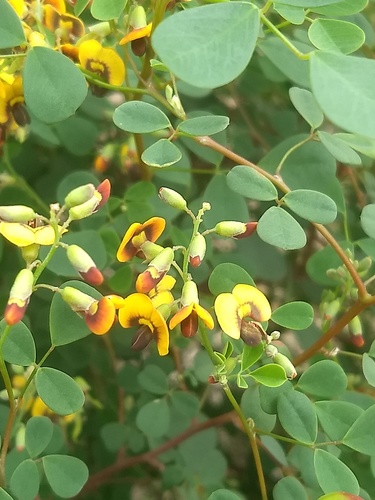
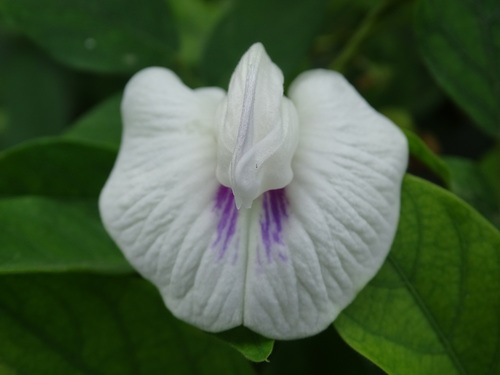
Centrosema pubescens Benth., commonly called centro, is a perennial herb that reaches a maximum height of 45 cm (17.5 in). Its root system can grow up to 30 cm deep, and is frequently associated with Rhizobium, a type of nitrogen-fixing bacteria. Stems grow and branch rapidly, creating a dense layer of branches and leaves across the soil surface. Stems do not become woody until roughly 18 months after planting. The leaves are trifoliate, with elliptical leaflets that measure approximately 4 cm × 3.5 cm (1.6 in × 1.4 in). The upper surface of leaflets is dark green and glabrous, while the lower surface is whitish and densely tomentose. Flowers are typically pale violet with darker violet veins, and grow in axillary racemes. The fruit is a flat, elongated, dark brown pod 7.5–15 cm (3.0–5.9 in) long, which holds up to 20 seeds. Ripe seeds are spherical, about 4 mm (0.16 inches) in diameter, and dark brown. This species is invasive in New Caledonia. Centrosema pubescens is widely used as forage and a protein source for grazing cattle across the range from southern Mexico to Colombia. It was cultivated as a crop in Indonesia and the Malay Peninsula in the nineteenth century. It is well adapted to tropical conditions and grows at altitudes below 600 m above sea level. It is grown as a cover crop because it naturally suppresses weeds and has very high drought tolerance. Centro cannot tolerate cold temperatures, but has very low requirements for soil quality and rainfall. It is not suitable for human consumption, but provides benefits for soil fertility and animal health. It can be cultivated in regions with annual rainfall between 1000 mm and 1750 mm. Its deep root system gives it reasonable drought tolerance, allowing it to access water from a significant depth. It grows well in nutrient-poor soils. It can be intercropped with grasses to increase the protein content of cattle diets. Its leaves can also be used as an inexpensive protein source for broiler chickens, and it is a good source of calcium and potassium for animals. Recorded recent production figures for selected regions are: Brazil averages 40 tonnes per year; Uganda produces 220–275 kg per hectare, with 1250 seeds per m²; in Queensland, dry production is 12.8 tonnes per hectare per year, and production for animal feed is 550–650 kg per hectare per year; Colombia produces 7.6 tonnes per hectare per year. Seeds of Centrosema pubescens have mechanical dormancy that must be broken by soaking the seeds for 3–5 minutes in 85 °C water. After dormancy breaking treatment, seeds can be inoculated with Rhizobium and planted with a no-till planter. A typical planting depth for seeds is 2.5–5 cm: the shallower depth is used when soil moisture is adequate, while seeds are planted deeper to reach moisture in dry soil. Centrosema pubescens is a promising forage for regions seeking an alternative to boost the protein content of livestock feed. It is easy to manage, improves soil nitrogen levels, and does not require special technology or equipment for planting.