About Centropus bengalensis (Gmelin, 1788)
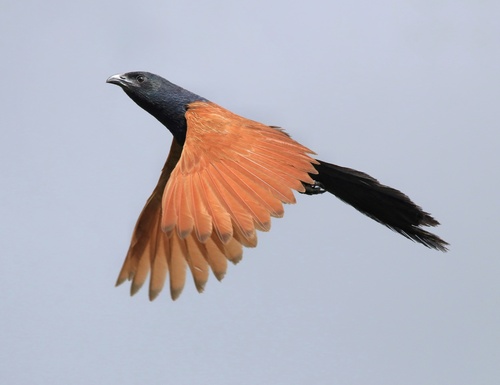
Centropus bengalensis, commonly called the lesser coucal, is a slightly smaller, shorter-billed coucal species with the longest hind claw of any member of its genus. Like many other coucals, it has an overall blackish plumage, a long tail, and rufous wings. This species has two distinct plumage phases. In breeding plumage, the head and upper back are glossy, with dark feather shafts. In non-breeding plumage, the head and back have whitish feather shafts, and the plumage is duller overall. Pale shafts on wing coverts appear as whitish streaks against brown feathers. Its central upper tail coverts are very long and barred. Unlike the greater coucal, the lesser coucal has a darker brown iris, not crimson red. Juveniles are browner overall, with black spots and bars. The calls of the lesser coucal consist of a series of low double "whoot-woot" or "kurook" notes, which increase in tempo and descend in pitch. The Indonesian name for this species, dudut, is onomatopoeic. This species has a wide distribution, ranging west from the Indian subcontinent (it is not found in Sri Lanka, despite an old report of a skin of doubtful provenance) eastward across Southeast Asia. Slight size and plumage differences have been observed across its range, leading to the designation of several subspecies. The nominate subspecies occurs from India to Thailand. Subspecies lignator is larger, and is found in southeastern China and Taiwan. Subspecies javanensis is smaller, and occurs across the larger islands along the Malay Peninsula, extending east to the Philippines. Larger island forms include subspecies sarasinorum, which is found on Sulawesi, the Sula Islands, the Lesser Sundas, and Timor. The Moluccas subspecies medius is the largest of all described forms. Some other proposed subspecies, including philippinensis from the Philippines and chamnongi from Thailand, are not universally recognized, and are thought to be either plumage variants or intermediate forms. The patchily distributed population of the Western Ghats in southern India may represent a distinct unrecognized subspecies. In terms of behaviour and ecology, the lesser coucal occurs alone or in pairs, staying low in the undergrowth of marshy or grassy areas adjacent to forest. It is found mainly in lowlands. Like other coucals, it is a cuckoo that does not practice brood parasitism. Its nesting season runs from May to September, with most nesting occurring after the rains in June in India. It builds a domed nest from grass blades in a low tree. The average clutch size is 3 eggs in India, 2 eggs in Southeast Asia, and 4 eggs in Taiwan. Both sexes participate in incubating eggs and caring for the young.