About Centipeda cunninghamii (DC.) A.Braun & Asch.
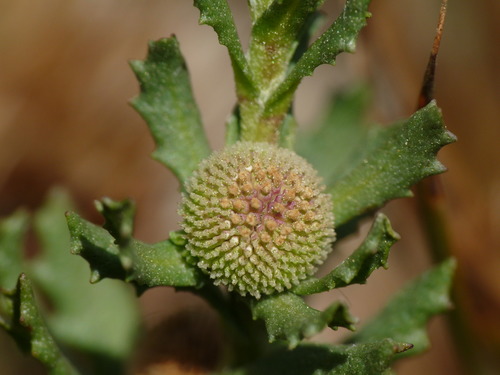
Centipeda cunninghamii (DC.) A.Braun & Asch. is an erect or ascending perennial herb in the daisy family (Asteraceae), endemic to Australia. It is glabrous, or rarely woolly, and grows to around 20 cm (8 inches) high, with much-branched stems. Its leaves are oblong to more or less spathulate, measuring approximately 15 mm (1/2 inch) long and 3–4 mm (1/10 inch) wide. Leaf margins are shallowly toothed or subentire, and the leaf blades narrow toward the base with an indistinct petiole. Its inflorescences are tiny, globular flower heads that can be green, or sometimes red or pink. Flower heads are sessile, usually solitary, and roughly globose to biconvex, 4–8 mm (1/5 inch) in diameter. Involucral bracts are roughly obovate, 2–3 mm long, with an obtuse apex and minute teeth. Female florets are usually arranged in 6 to 8 rows. There are 10 to 30 bisexual florets. The fruit consists of clavate achenes, about 2 mm long, with a rounded apex and glabrous texture above the ribs. Flowering occurs mostly from spring to autumn, which corresponds to September to February. Fruiting occurs from October to June. It most commonly grows in damp areas that are subject to flooding, across a range of soil types, from coastal to montane habitats up to 600 m above sea level. It is especially common in muddy or silty ground left by receding waters along the margins of lakes, ponds, streams, and rivers. It can also be found in muddy hollows in rough pasture and paddocks, in tussock grassland, in damp depressions within dune swales, and sometimes in similar damp sites within urban areas. Within Australia, it occurs in all mainland states, Tasmania, and all New South Wales subdivisions except the North Coast; it is also found in New Zealand, and has been accidentally introduced and recorded in Europe. Centipeda cunninghamii can be easily grown from fresh seed or cuttings, but has a tendency to become invasive. It has a long history of traditional use by Australian Aboriginal peoples for treating wounds, infections, and inflammation. The most common traditional method of use involves binding the plant's leaves directly to the forehead or other body parts, so that body heat releases the plant's oils to be absorbed through the skin. It can also be taken orally, sometimes mixed with emu fat, or boiled or soaked in water to make a tea. Traditional medicinal practitioners caution that dosage must be carefully regulated for oral ingestion, as the plant can be toxic if taken in large amounts.