About Centella asiatica (L.) Urb.
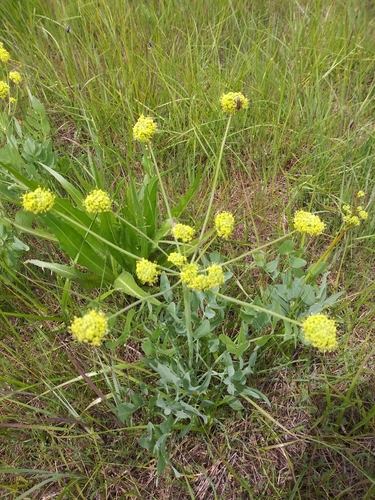
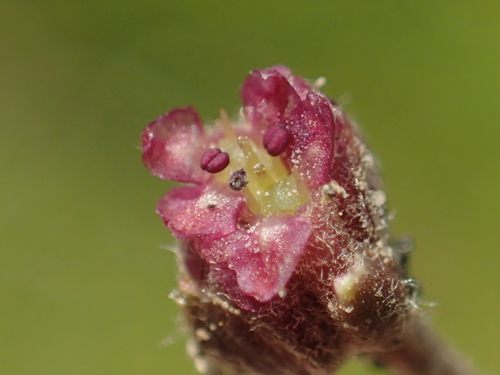
Centella asiatica grows in temperate and tropical swampy areas across many regions of the world. Its stems are slender, creeping green to reddish-green stolons that connect individual plants to each other. This species produces long-stalked green leaves; the leaf blade has a rounded apex, smooth texture, and palmately netted veins, and the leaf stalk broadens at the base into a leaf sheath. Its root system is made up of vertically growing rhizomes, which are cream-colored and covered in root hairs. The flowers are either white or crimson, and grow in small, rounded umbels near the soil surface. Each flower is partially enclosed by two green bracts. These minute hermaphrodite flowers measure less than 3 mm (0.12 in), with five to six corolla lobes per flower, five stamens, and two styles. The fruits of Centella asiatica are densely reticulate, which distinguishes it from Hydrocotyle species, which have smooth, ribbed, or warty fruits. When cultivated, the crop matures in three months, and the entire plant including the roots is harvested manually. It is classified as a highly invasive high-risk plant, and has many common names across the areas where it is distributed. Centella asiatica is native to the Indian subcontinent (including Sri Lanka), Southeast Asia, parts of Australia, and wetland regions of the Southeastern United States. As an aquatic plant, it is especially sensitive to biological and chemical water pollutants, which the plant can absorb. It can be grown in drier soils such as sandy loam, as long as it receives regular watering, which makes it suitable for cultivation in home gardens. In traditional medicine, Centella asiatica has been used with the goal of treating various disorders, dermatological conditions, and minor wounds. However, clinical research has not confirmed its clinical efficacy or safety. Topical application can cause contact dermatitis and skin irritation, and consuming the plant may lead to drowsiness. For phytoremediation purposes, Centella asiatica is a potential phytoextraction tool, due to its ability to take up heavy metals from contaminated soil and translocate them from its roots to its shoots.