About Centaurea virgata Lam.
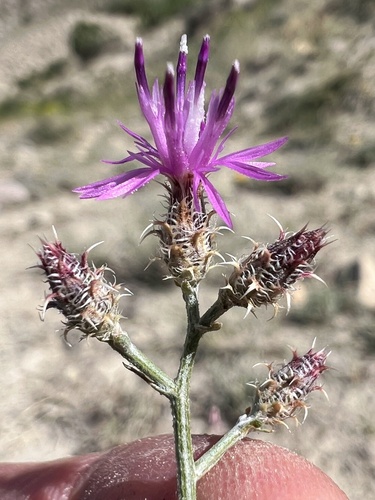
Centaurea virgata Lam. is a taprooted perennial plant that can grow up to 36 inches tall. Older individuals may develop multiple rosettes above their long taproot, which lets the species thrive in dry locations. Its flowers are arranged in slender, urn-shaped heads, holding 4 to 8 flowers per head. Flower heads curve slightly downward, visually resembling smaller versions of diffuse knapweed (Centaurea diffusa Lam.) but bear rose-purple flowers. Each flower head is formed from a cluster of bracts, with the tip of each bract bent outward. This bent bract shape often lets flower heads attach to passing animals, enabling long-distance seed dispersal. Seeds are pale brown; without animal assistance, seeds can disperse up to 60 feet from the parent plant. Because of its adaptation to dry conditions, it can be more invasive than diffuse knapweed on severely dry rangelands. This species is native to Asia, where it is common in Western and Middle Asia, the Caucasus region, and Xinjiang, China. It has been introduced to North America, occurring specifically in northern California, Idaho, Utah, and eastern Oregon. Its presence has also been recorded in France and countries along the Dalmatian Coast.