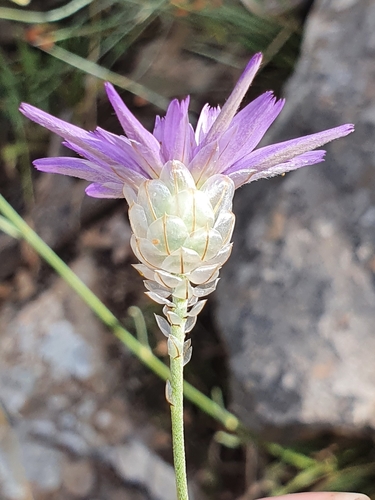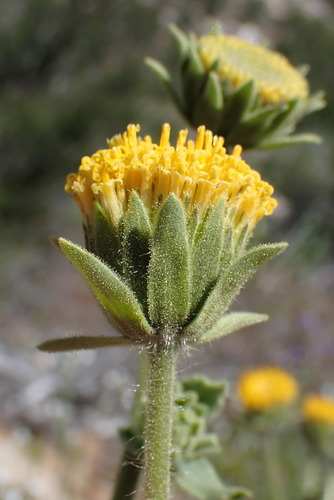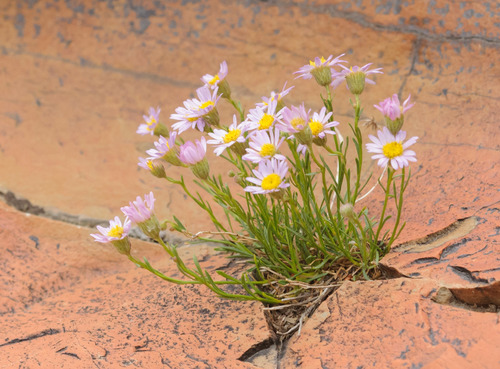
About Centaurea stoebe L.
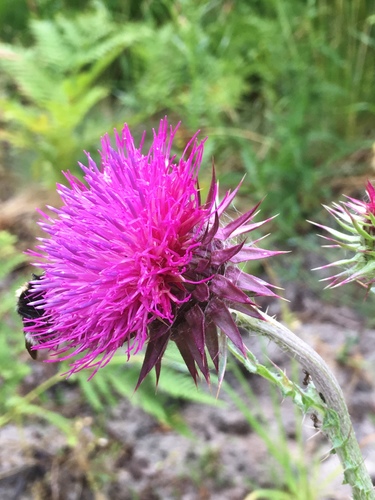
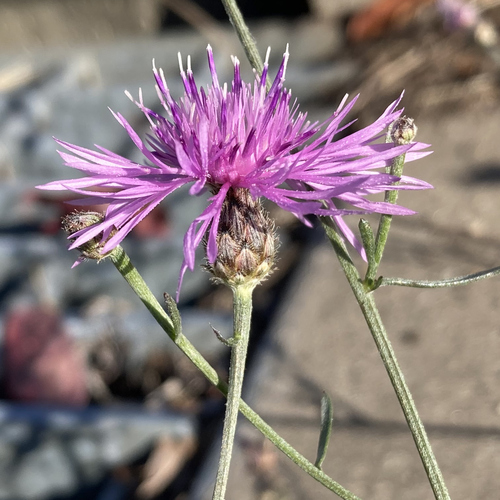
Centaurea stoebe L. is a biennial or short-lived perennial plant, which typically develops a stout taproot and has pubescent stems when young. Its leaves are pale, deeply lobed, and covered in fine short hairs. First-year plants grow a basal rosette of alternate leaves, which reach up to 15 centimetres (6 inches) long and are deeply divided into lobes. The plant produces a stem in its second year of growth. Stem leaves become progressively less lobed and smaller toward the top of the stem. The stem is erect or ascending, slender, hairy, and branching, and can grow up to 0.91 metres (3 feet) tall. Flowers bloom from July to September, protruding from black-tipped sepals. The flower head is 10 millimetres (3⁄8 in) wide, and holds vibrant pink to lavender (or more rarely white) disc flowers around 2 cm (3⁄4 in) long; the corolla of each disc flower has five narrow lobes. The fruit is an achene about 6.4 mm (1⁄4 in) long, with a short, bristly pappus. Achenes are primarily dispersed by wind, sometimes with assistance from the plant's tumbleweed mode. This species is native to eastern Europe. It is an invasive species in southern Canada, northwestern Mexico, and nearly every state in the United States; it has thrived particularly in the western United States, most of which has a dry climate similar to the Mediterranean. Centaurea stoebe grows on stream banks, pond shorelines, sand prairies, old fields and pastures, roadsides, along railroads, and in many open and disturbed areas. It is relatively tolerant of cold and grows into alpine environments. Centaurea stoebe was introduced to North America, where it is considered an invasive species across much of the western US and Canada. In 2000, C. stoebe occupied more than 7 million acres (28,000 square kilometres) in the US. Also called spotted knapweed, this species is a pioneer species found in recently disturbed sites or openings, where it grows in dense stands. As such, human disturbance is a major cause of infestations. It readily establishes itself and quickly expands in areas altered by human activity such as industrial sites, roadsides, and sandy riverbanks. Once established, it also has the potential to spread into undisturbed natural areas. Because cattle prefer native bunchgrass over knapweed, overgrazing can often increase the density and range of knapweed infestations. This species is thought to have several traits that contribute to its extreme competitive ability: a tap root that absorbs water faster than the root systems of its neighbors, rapid dispersal through high seed production, low palatability that makes it less likely to be eaten by grazing animals, and purported allelopathy that lets it thrive by stunting the growth of neighboring plants. A 2003 study showed that under projected future global atmospheric carbon levels, C. stoebe exhibits increased growth with higher atmospheric carbon, which could potentially expand its range and let it outcompete native species. There is an unconfirmed rumor that handling the plant with bare hands may cause tumors, particularly if there is an open wound, but there is little evidence to support this claim.