About Centaurea solstitialis L.
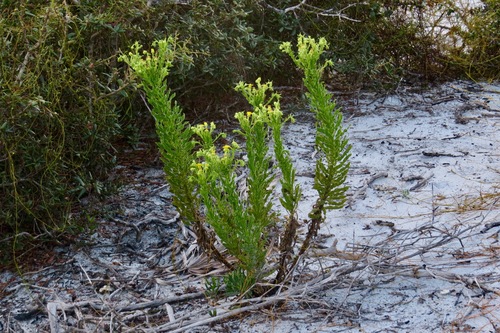
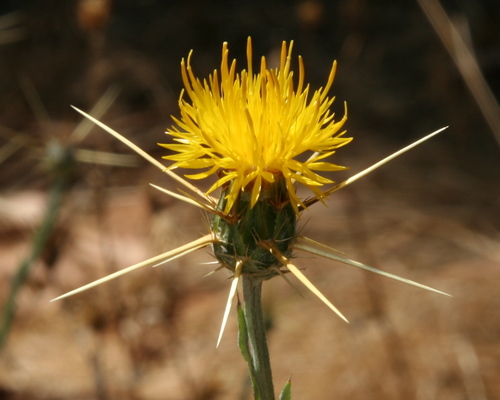
Centaurea solstitialis L. (commonly called yellow star-thistle) is an annual herb in the Asteraceae family. During its vegetative growth stage, it forms a rosette of non-spiny leaves 5 to 20 centimeters (2 to 8 inches) in diameter. As summer approaches, it produces a flowering stem that can grow up to 1 meter (3 and 1/2 feet) in height. Basal leaves are lobed and 5 to 8 centimeters (2 to 3 inches) long, while stem leaves are smaller and unlobed. From May to October, the stem produces numerous spinous flower heads called capitula, each 12 to 16 millimeters (1/2 to 5/8 inch) across, that hold 10 to 50 yellow flowers. The spines on the flower heads measure 1 to 2.5 centimeters (3/8 to 1 inch) long. Flowers are pollinated by insects, and each capitulum produces 10 to 50 seeds, some with a pappus and some without. It is an annual semelparous species, meaning it dies after reproduction is complete, usually by the end of summer. In its native European range that includes Turkey, Greece, Italy, France, and Spain, Centaurea solstitialis is already considered a weed. It typically grows in highly disturbed ruderal habitats, most commonly on roadsides and the margins of cereal crop fields. After being introduced to many other parts of the world as an exotic species, including Australia, Argentina, Chile, and the United States, it has developed local adaptations to the new habitats it colonized. Researchers have detected an incipient level of reproductive isolation between native and non-native populations, which is an example of ecological speciation. Star-thistle is a valuable source of pollen and nectar for pollinators. In California, where it is a well-documented pest plant, yellow star-thistle is a major nectar source for many butterflies in the state's central valleys and foothills. It colonizes ground that has been damaged by being dry, compacted, or scraped clean. As a plant with a taproot system, it plays an important role in soil restoration by bringing vital micronutrients up to the topsoil. Like many plants classified as weeds, it quickly establishes in, protects, and restores soil that has been left exposed by natural and human-caused disturbances, in the words of Mark Schonbeck. In its native Eurasian ecosystems, Centaurea solstitialis grows as a balanced part of the community, kept in check by a range of natural herbivore enemies and co-evolved plant species. However, in most non-native regions where it has been introduced, the natural biological controls from its native range are absent, and it has become an invasive species and noxious weed. Yellow star-thistle can form monotypic stands in cultivated field soil, graded dirt sites, and disturbed natural lands. Its colonization eliminates existing native plants and prevents other plant species from growing, reducing habitat biodiversity. Extensive monotypic stands of yellow star-thistle are common in invaded areas. Its growth plasticity, strong competitiveness, preference for Mediterranean climate, and lack of natural herbivore enemies and co-evolved species make it a very successful invader. As an invasive pest, it harms field crop production, degrades native plant habitats and natural ecosystems, blocks domestic animals from grazing on rangelands, and forms a physical barrier that hinders movement of native wild animals. Grazing on this plant by horses can cause nigropallidal encephalomalacia, also known as "chewing disease", a neurological condition. This disease typically develops after a horse consumes an amount equal to 60 to 200% of its body weight over a month or longer, or 2.3 to 2.6 kilograms (5.1 to 5.7 pounds) of star-thistle per 100 kilograms (220 pounds) of body weight per day. Star-thistle is most dangerous when it is the only plant available for grazing or when it contaminates dried hay, and horses may even develop a taste for it and actively seek it out. Many other grazing species, including mules and burros, are not affected by the toxin. Although the spines make the plant difficult to handle, it is used to produce a light, mild honey.