About Centaurea nigra L.
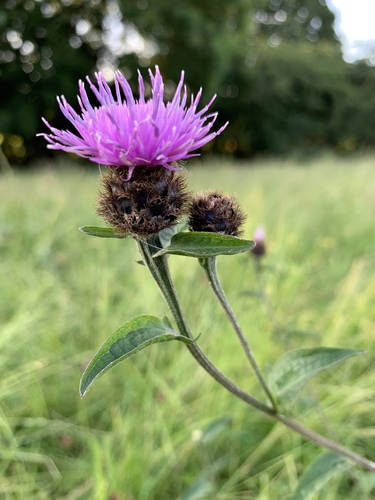
Centaurea nigra L. is an upright herbaceous perennial that reaches approximately 1 meter (3.3 feet) in height, and produces spreading rhizomes. It first grows a basal rosette of leaves, which are typically entire and can grow up to 30 centimeters (11.8 inches) long. After the rosette is fully developed, it produces upright stems, and the original rosette eventually dies away. The mature upright stems turn purple. Stem leaves are smaller, measuring 1-8 mm by 2-10 mm; they are usually entire, grey-green, and covered in rough hairs. The inflorescence is globe-shaped, measuring 10-20 mm by 30-40 mm, and holds small purple to reddish flowers fringed by black or dark brown bracts. The fruit (seeds) are light brown, flattened and ovoid, 3-4 mm long, and topped with short bristles of around 1 mm. In its native range, flowering takes place from summer to autumn, between June-July and September. Compared to other perennial meadow flowers in Britain, Centaurea nigra produces high amounts of nectar and pollen. Its nectar, pollen, and seeds are very important food sources for many species of invertebrates and birds. In its native range, when planted alongside a mix of other forbs such as on field margins, C. nigra can greatly improve biodiversity values and ecosystem services including pollination. In its introduced range, C. nigra is often classified as a weed because it outcompetes and excludes native vegetation, and can lower agricultural potential. In the United States, it invades meadows, excludes native vegetation, and negatively impacts native biodiversity. In Australia and New Zealand, C. nigra is known to invade grasslands, wastelands including railway lines, roadsides, and other waste areas, as well as agricultural lands.