About Centaurea macrocephala Muss.Puschk. ex Willd.
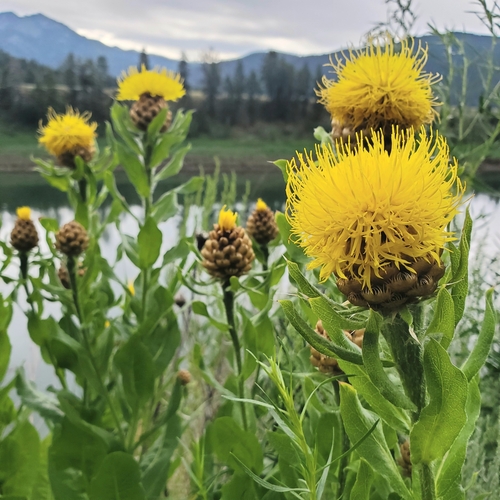
This is a herbaceous perennial plant. It grows mostly unbranched stems that can reach a height of up to 170 cm. Its leaves vary in shape and size: leaves near the plant’s base have oval blades and grow on petioles, while leaves higher up the plant are shorter and narrower. Flower heads grow singly at the tops of stems, with clusters of small leaves at their bases. Each head is between 2.5 and 3.5 cm wide. The somewhat rounded head is covered in layers of phyllaries that have fringed tips, and sometimes spines. Many yellow florets grow inside each head. The fruit, including its attached pappus, can measure well over one centimeter in length.
This species has been transported globally for ornamental use, and has become established as an introduced species in several regions outside its native range. It occurs as a casual garden escapee in parts of Europe and North America. It has only become a problematic noxious weed in a small number of areas, most notably Washington state in the United States, where buying or selling this species is prohibited. Its invasive behavior is most commonly observed in garden settings, where it grows more aggressively than most other ornamental plants and can become a so-called "garden thug".
This is a well-known ornamental flowering plant, and has been grown as a garden flower for over 200 years. It was introduced to the United Kingdom and the United States in the early 19th century. Thomas Jefferson acquired seeds from nurseryman Bernard McMahon and planted the species at Monticello. In gardens, it can be planted along borders or in corners, where it will grow into clumps. It is used as a cut flower for its large, rounded heads with long yellow florets, and can also be used as a decorative dried flower. It is the largest Centaurea species in cultivation, and is easily recognized.