About Centaurea cyanus L.
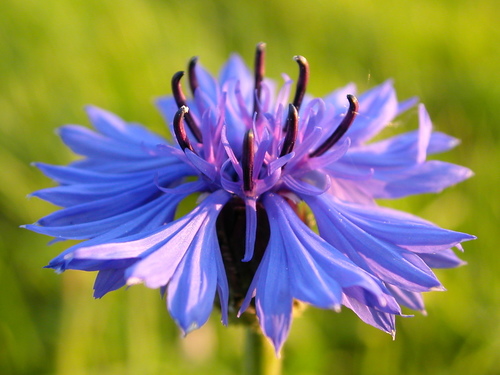
Centaurea cyanus L. is an annual plant that reaches 20 to 100 centimeters (8 to 39 inches) in height, with branched, grey-green stems. Its leaves are lanceolate in shape, and measure 3 to 10 cm (1 to 4 in) in length. The flowers are most often an intense blue, arranged in rounded flowerheads called capitula that are 1.5 to 3 cm in diameter. A ring of a few large, spreading ray florets surrounds a central cluster of disc florets in these flowerheads. The blue pigment in C. cyanus is protocyanin, which appears red in roses. The plant produces fruits that are approximately 3.5 mm long, with 2 to 3 mm-long pappus bristles, and it flowers throughout the entire summer. C. cyanus is native to temperate Europe, but it has been widely naturalized in many other regions of the world, including North America and parts of Australia. It was introduced to these areas both as an ornamental garden plant and as a seed contaminant in crop seeds. It has been an archaeophyte, meaning an ancient introduction, in Britain and Ireland since the Iron Age. In the United Kingdom, the species has declined from 264 sites to just 3 sites over the last 50 years. In response to this decline, the conservation charity Plantlife named C. cyanus as one of 101 species it will actively work to bring back from the brink of extinction. In County Clare (VC H9), Ireland, C. cyanus is recorded as very rare and almost extinct in arable fields, while it was abundant in northeast Ireland before the 1930s. Several cultivars of C. cyanus have been selected for ornamental use, with flowers in a range of pastel colors including pink and purple. The species is also grown commercially for the cut flower industry in Canada for florist use. Doubled blue cultivars such as 'Blue Boy' and 'Blue Diadem' are the most common for this use, though white, pink, lavender, and black (actually a very dark maroon) cultivars are also used, though less often. C. cyanus contains a wide range of pharmacologically active compounds, including flavonoids, anthocyanins, and aromatic acids. The flower head is especially widely used in herbal medicine, though leaves and seeds are also used for pharmacological purposes, to a lesser degree. Flower head extracts of C. cyanus have anti-inflammatory properties, and are used to treat minor ocular inflammations. The plant has high antioxidant properties, due to its content of ascorbic acid and phenolic compounds. Additionally, extracts of the flower head and vegetative parts of the plant have been shown to have gastroprotective effects, from their content of quercetin, apigenin, and caffeic acid derivatives.