About Centaurea alba L.
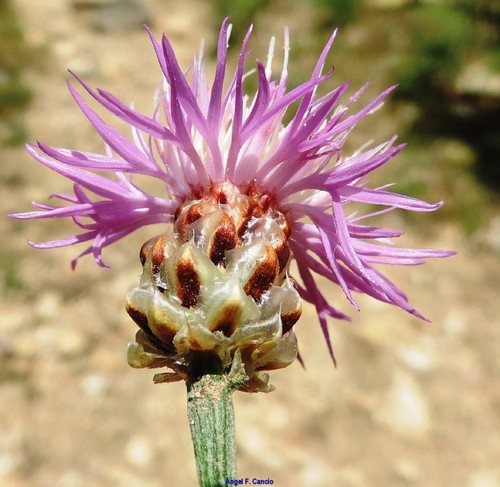
Centaurea alba L. is most similar to Centaurea costae, and is primarily distinguished from it by the shape of its involucral bracts: C. costae has bilobed bracts. This species has three accepted subspecies: Centaurea alba subsp. alba, Centaurea alba subsp. aristifera, and Centaurea alba subsp. tartesiana. Centaurea alba subsp. alba additionally includes three varieties: var. alba, var. latronum, and var. macrocephala. This species is only native to the Iberian Peninsula, where it generally grows at inland sites in the central, central-north, central-western, and southwestern parts of the peninsula. In Spain, it has been recorded in the provinces of Ávila, Badajoz, Burgos, Cádiz, Cáceres, Ciudad Real, Cuenca, Guadalajara, Huelva, León, Madrid, Salamanca, Sevilla, Segovia, Soria, Toledo, Valladolid, Zaragoza, and Zamora. In Portugal, it occurs in Beira Baixa and Ribatejo Province. The currently recognized different subspecies and varieties are largely not sympatric, and each has distinct geographical distributions. Two taxa have disjunct distributions: subsp. tartesiana occurs south of the species' main distribution, and var. macrocephala occurs even further south, at the southernmost tip of continental Spain. The var. macrocephala disjunct population is restricted to the southernmost tip of Spain, ranging from the mouth of the Guadalquivir (which empties into the Gulf of Cádiz) northeastwards into the Baetic Depression, and lies entirely within the Province of Cádiz. Subspecies tartesiana is endemic to the northwest corner of Andalusia. It occurs in the western part of the Sierra Morena mountain range, in the provinces of Huelva and Sevilla. For a long time, Centaurea alba was thought to also grow in northeast Algeria. According to López, this belief originated from a single specimen sheet in Georges Rouy's personal herbarium. The specimen was actually collected in Segovia in 1905, but was accidentally placed into the Plantes d’Algérie section of the herbarium. This specimen is one of five duplicates, and one of these duplicates is the lectotype of Centaurea segoviensis, which is now a synonym of subspecies alba. However, Jules Aimé Battandier had already described Centaurea alba var. mauritanica as growing in Algeria in his 1889 Flore de l'Algérie, and an Algerian population of Centaurea was referred to as C. alba in local floras until the 2000s. Examples of this include the 1963 Nouvelle flore d'Algérie, and a 1985 French collection of the species from Djebel Ich Ali near Tazoult in Batna wilaya. This Algerian population is now recognized as C. djebel-amouri, a new species described by Greuter in 2003, and the former application of the name C. alba to this population is now classified as "auct. Afr. N. non L.". Plants from Italy, France, and possibly Albania have also been historically misidentified as C. alba. In terms of ecology, Centaurea alba blooms from April to October. It inhabits woodland clearings and forest fringes, especially in pine forests, oak forests, and melojares (Quercus pyrenaica forests). It also grows in matorral, wasteland, drainage ditches, on slopes, and in roadside verge habitat. It has been recorded growing at altitudes between 3 and 2,000 metres. It prefers somewhat fertile, or not excessively fertilised, soils that can range from acidic to alkaline. It usually grows in rocky, large-grained soil, very often calcareous soil mixed with silicates. The var. macrocephala grows in matorral habitats on substrates derived from calcarenite and limestone. The subspecies tartesiana grows in soils based in slate and marl.