About Cenchrus tribuloides L.
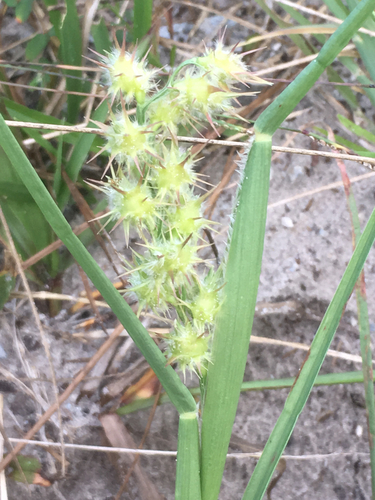
Cenchrus tribuloides L., commonly known as dune sandbur, is an annual plant species. This species grows individuals that form small, spiky pods. Its flowers are typically small and not produced in large numbers. Leaves are arranged in two ranks, and the plant's internodes are hollow. Plants may be either tall or short. All spikelets are bisexual and identical in appearance. Spikelets are held within hard burs that bear hard, stiff spines. Each tiny bur encloses 1 to 8 spikelets, and the spines have small downward-pointing barbs near their tips. Pieces of these spines can break off under human skin and cause significant pain. The species is easily identified by its densely hairy, cup-shaped burs which measure 10–15 mm wide when including the spines. Burs usually hold 15 to 43 spines, are arranged in spikelike racemes, and attach to swollen pedicels. The plant's leaf sheaths are inflated, and leaf blades are usually folded. It is native to the eastern and Gulf coast of the United States, where it occurs naturally in Maine, Vermont, Massachusetts, Rhode Island, Connecticut, Pennsylvania, Maryland, Delaware, Virginia, North Carolina, South Carolina, Georgia, Alabama, Florida, Mississippi, and Louisiana. It is also native to Brazil, the Bahamas, Bermuda, the Cayman Islands, Cuba, Haiti, Jamaica, and Puerto Rico. In Hawaii it is an invasive plant, and it is classified as a threatened species in New York. It can be found growing along coastal United States from Mississippi to New York. Dune sandbur grows in dunes, loose sand, thin woods, and open areas, and typically has a sprawling growth habit. It is most prominent during the months of August and September.