About Celtis reticulata Torr.
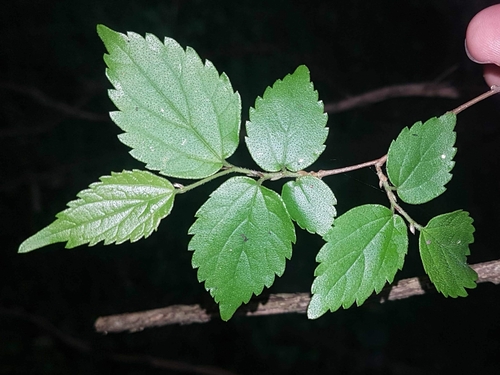
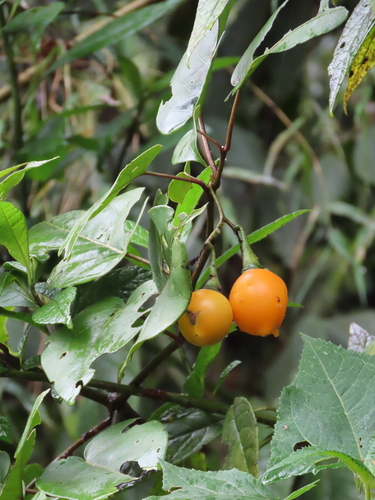
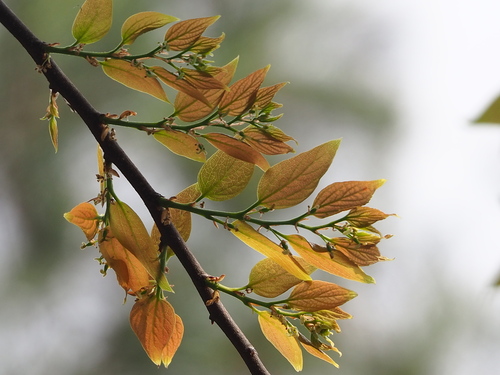
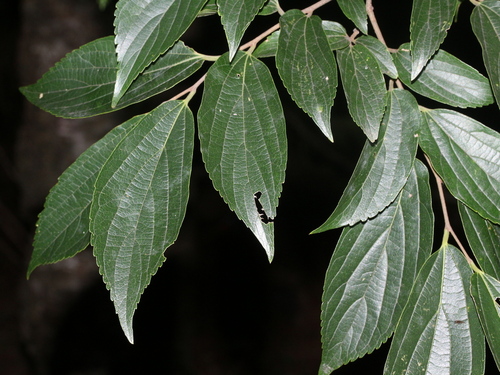
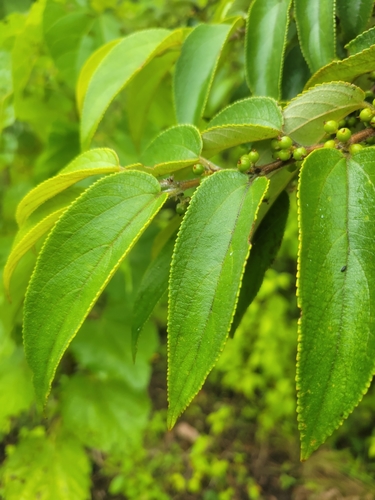
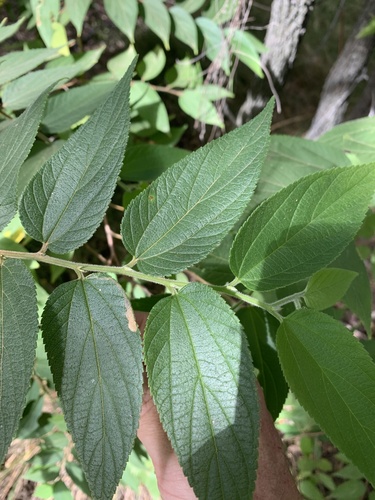
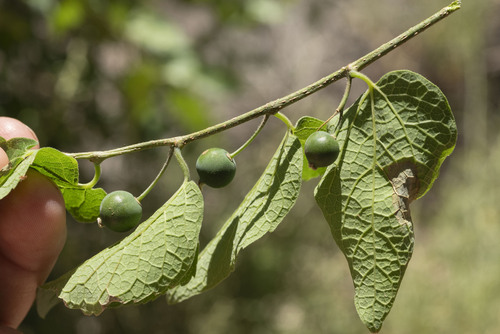
Celtis reticulata Torr. is most commonly a small tree, reaching 6 to 9 meters (20 to 30 feet) in height with a mature trunk diameter of 15 to 35 centimeters (6 to 14 inches). Some individual plants have been recorded growing as tall as 21 meters (70 feet) with a trunk diameter up to 60 centimeters (24 inches). It often grows with a scraggly, stunted form, and sometimes grows as a large bush. This species grows at altitudes between 500 and 1,700 meters (1,600 and 5,600 feet). The bark of this hackberry species ranges from gray to brownish gray. Trunk bark develops vertical corky ridges that form a checkered pattern between the furrows. Young twigs are puberulent, meaning they are covered in very fine hairs. Leaf blades are 2 to 8 centimeters (3⁄4 to 3+1⁄4 inches) long, most often around 5 to 6 centimeters (2 to 2+1⁄2 inches). Leaves are shaped from lanceolate to ovate, with an uneven base. They have a leathery texture, with edges ranging from smooth to toothed, and they tend toward toothed margins. Leaves are distinctly net-veined, with a base ranging from obtuse to roughly cordate, and a tip ranging from obtuse to acuminate. The leaf surface is scabrous; the upper surface is dark green, while the lower surface is yellowish-green. Petioles, the small stalks that connect the leaf blade to the stem, are generally 5 to 6 millimeters (3⁄16 to 1⁄4 inch) long. The flowers are very small, averaging 2 millimeters across. They grow either singly or in cymose clusters, with fruit pedicels measuring 4 to 15 millimeters long. The fruit is a rigid berry ranging from brownish to purple, 5 to 12 millimeters in diameter, with thin, sweet pulp. If left uneaten, fruit can remain on the plant through early winter. In its ecology, the leaves are eaten by many types of insects, especially certain moth caterpillars. Wildlife including birds eat the berries. Mule deer and bighorn sheep feed on the plant's fresh twigs, and beavers also feed on this species. Celtis reticulata is cultivated by plant nurseries, and is sold as an ornamental plant for native plant gardens, drought-tolerant gardens, natural landscape gardens, and habitat gardens. It is also used for ecological restoration projects. The berries and seeds of Celtis reticulata have long been used as a food source by Native Americans of the Southwestern United States. This includes the Chiricahua and Mescalero Apache, who eat the fruit both fresh and preserved, and the Navajo, who eat it both fresh and ground.