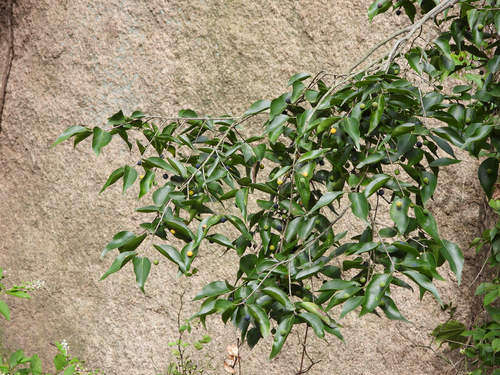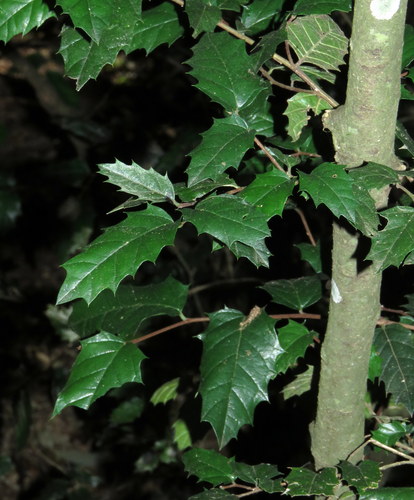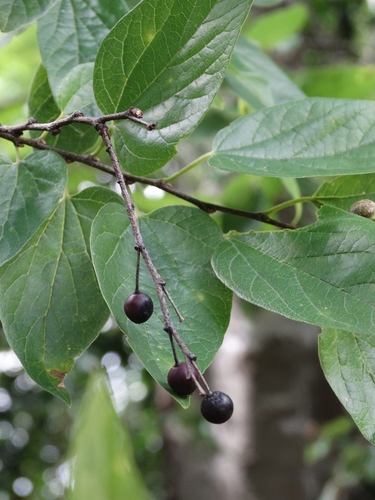
About Celtis laevigata Willd.
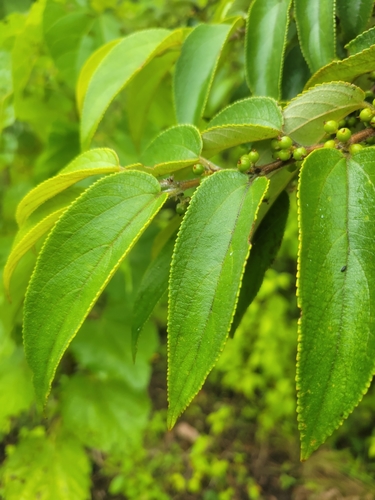
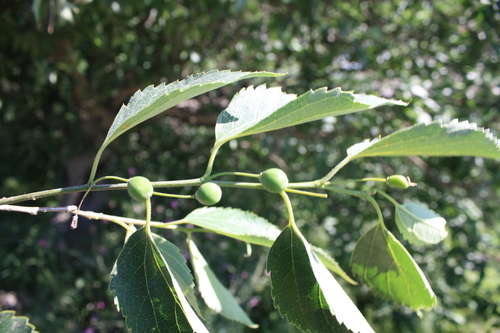
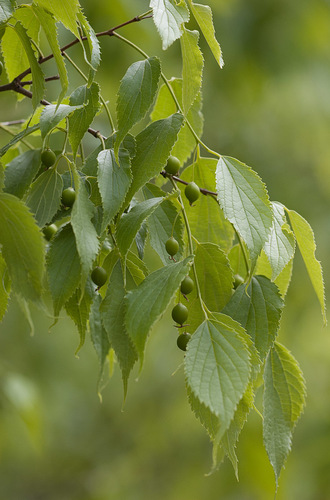
Celtis laevigata Willd. is a medium-sized tree native to North America. Its common names include sugarberry, southern hackberry, and in the southern United States, it is also called sugar hackberry or simply hackberry. Where their ranges overlap, sugarberry is easily confused with common hackberry (Celtis occidentalis). Sugarberry can be told apart by its narrower leaves that mostly have smooth margins, juicier and sweeter berries, and less corky bark. The two species also differ in habitat preference: where their ranges overlap, common hackberry grows primarily in upland areas, while sugarberry grows mainly in bottomland areas. The natural range of sugarberry extends from the southeastern United States west to Texas, and south to northeastern Mexico. It is also found on the island of Bermuda. In ecology, sugarberry grows primarily along streams and in moist soils on floodplains. Its sweetish fruit is eaten by birds and rodents, which help disperse the tree's seeds. A variety of insects feed on its leaves, including caterpillars of the Io moth (Automeris io). The leaf litter of sugarberry contains allelopathic chemicals that inhibit seed germination and growth of many other plant species. In cultivation and use, sugarberry is mixed with hackberry to produce the lumber known as hackberry. Small amounts of this lumber are used for dimension stock, veneer, and containers, but the main use of sugarberry wood is for furniture. The light-colored wood can be given a light to medium-brown finish that would require bleaching to achieve on other types of wood. Sugarberry wood is also used to make sporting goods and plywood. Sugarberry is frequently planted as a shade tree within its native range. It is well-adapted to urban environments, and its elm-like shape and warty bark make it an attractive landscape tree.