About Celmisia gracilenta Hook.fil.
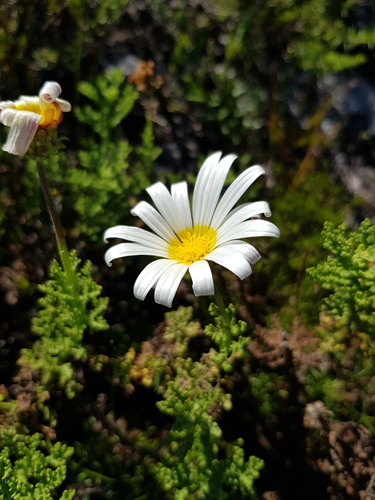
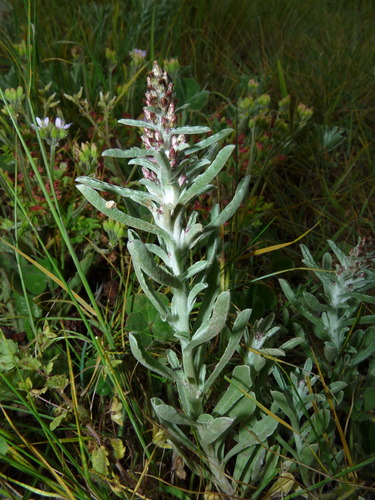
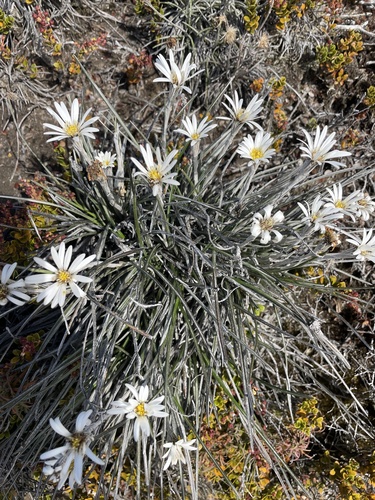
Celmisia gracilenta Hook.fil. is a slender, tufted herb with tough but flexible leaves. It has rolled, pale, thin, slightly hairy leaf sheaths that encircle the plant. Its leaves are typically linear, 10–15 cm long and 2–4 mm wide. The upper leaf surface is covered with a silvery membrane, while the underside is coated in white hairs. Leaves are grey-green with a mottled surface; margins are entire or nearly entire and strongly recurved. It produces a small number of slender, hairy flower stems 20–40 cm long, which hold a few leafy bracts and a single flower head 1.5–3 cm across. Narrow disc flowers sit at the center of the head, reaching up to 1 cm long, while ray flowers surround them on the outside, reaching up to 2.5 cm long. Flowers have white petals and a yellow pistil. Celmisia gracilenta was originally thought to be identical to Celmisia longifolia, but was later recognized as a distinct species in the genus Celmisia, and similarities between the two species have caused continued taxonomic confusion. Compared to other similar Celmisia species, Celmisia gracilenta has very slender, grass-like leaves, and its white flowers help distinguish it from related species native to the northern hemisphere. This species is endemic to New Zealand, occurring wild across the North Island, South Island, and Stewart Island. It is widespread from below the Coromandel Peninsula into subalpine herbfields and tussocklands, growing around low alpine levels up to approximately 1,700 m altitude. The highest confirmed recorded occurrence is 1595 m at Tukino, and the lowest is 1085 m in the Rangipo Desert. It occupies varied habitats across New Zealand’s two main islands, ranging from open subalpine scrub to herbfields, and can grow in areas with ultramafic soils such as the mineral belts of Marlborough-Nelson and Northwestern Otago. It is also found in bogs across the North Island (Te Ika-a-Māui) and South Island (Te Waipounamu). Soft down covering its leaves and stalks protects it from harsh mountain climates, giving it features well suited to mountainous environments. Commonly called the common mountain daisy, it is classed as alpine vegetation, and research suggests it is more tightly adapted to low alpine habitats than other habitat types. Celmisia gracilenta flowers from December to March. Its flowers are pollinated by insects. Seeds are around 5 mm long, attached to a downy crown of hairs that allows wind dispersal. Seed germination generally takes 4–6 weeks. Compared to other Celmisia species, Celmisia gracilenta is notably more common, a pattern linked to several of its traits: it produces lighter seeds with more bristles, has larger disc-to-ray flower ratios, smaller capitula, and taller scapes. It also requires less light and higher temperatures for seed germination than other Celmisia species. The Celmisia gracilenta complex is considered the most challenging group within the genus, and further molecular, morphological, and taxonomic study is needed.