About Celastrus orbiculatus Thunb.
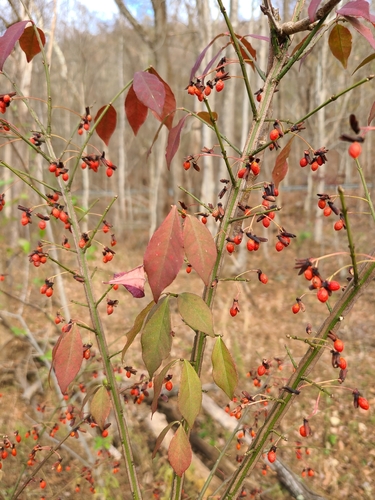
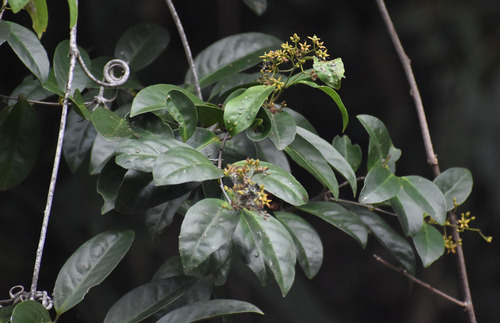
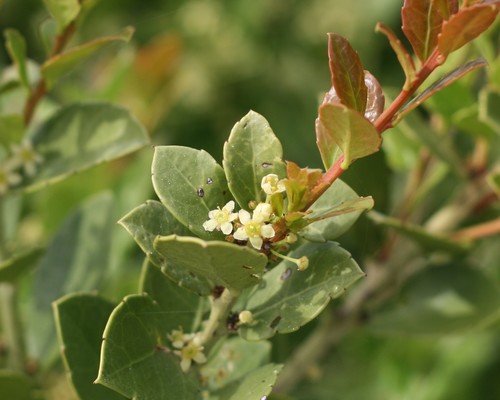
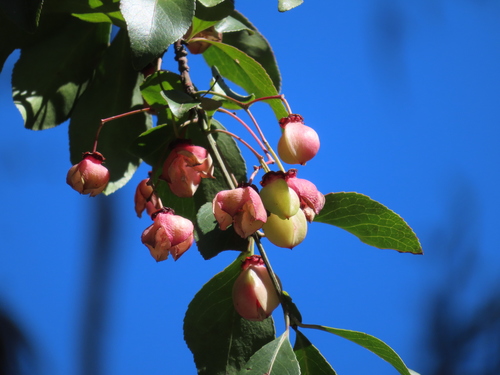
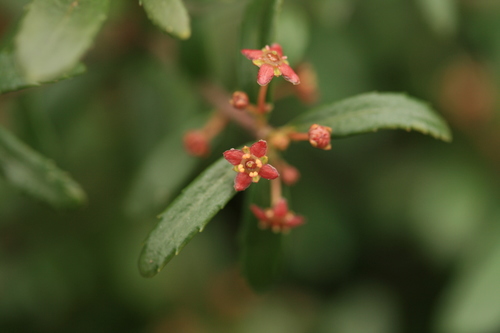
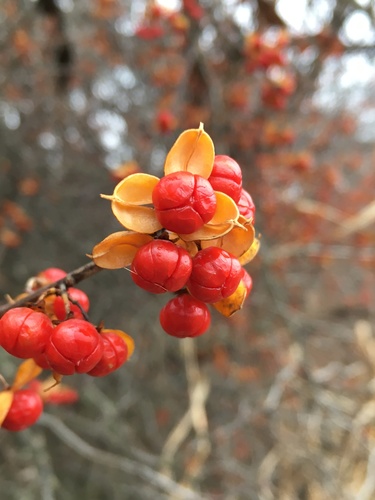
Celastrus orbiculatus Thunb. is a deciduous vine plant. Its defining feature is its thin, spindly vines with silver to reddish brown bark. Most vines measure between 1 and 4 cm (0.4 and 1.6 in) in diameter; when growth remains undisturbed, vines can grow larger than 10 cm (3.9 in) in diameter, and cut vines may show age rings indicating they are over 20 years old. When growing alone, this plant forms thickets. When growing near a tree, its vines twist around the host trunk up to 40 feet high. These encircling vines can strangle the host tree to death or break branches under their excess weight, a trait the species shares with the slower-growing native American species Celastrus scandens. Its leaves are round and glossy, 2–12 cm (0.8–4.7 in) long, have toothed margins, and grow in an alternate arrangement along vines. Small green flowers grow on axillary cymes. The fruit is a three-valved capsule that splits open to reveal bright red arils covering the seeds. All parts of this plant are poisonous. Due to repeated systematic disturbances to eastern forests from wood production and recreation, Oriental bittersweet (Celastrus orbiculatus) has become naturalized in landscapes, roadsides, and woodlands of eastern North America. In the United States, it ranges as far south as Louisiana, as far north as Maine, and as far west as the Rocky Mountains. It prefers mesic woods, where it can outcompete native plants. It is cultivated as an ornamental plant, and in the United Kingdom it has received the Royal Horticultural Society's Award of Garden Merit. Even though the fruit of this plant is moderately toxic, some livestock browse its leaves without any negative effects. Its durable, tough vines work well as weaving material for baskets. The fibrous inner bark can be used to make strong cordage.