About Celastrina neglectamajor Opler & Krizek, 1984
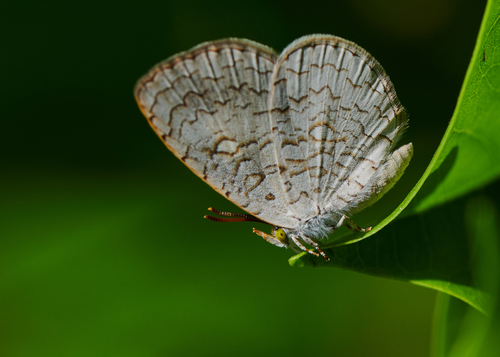
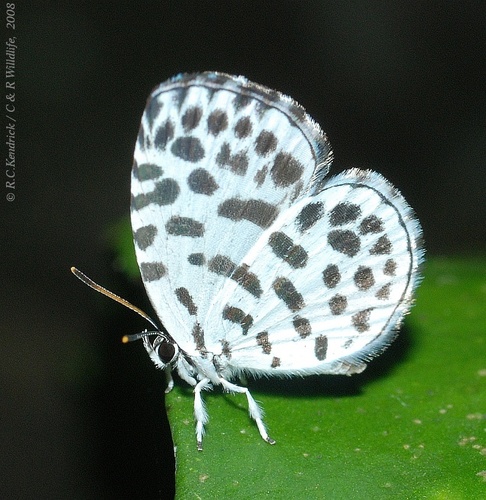
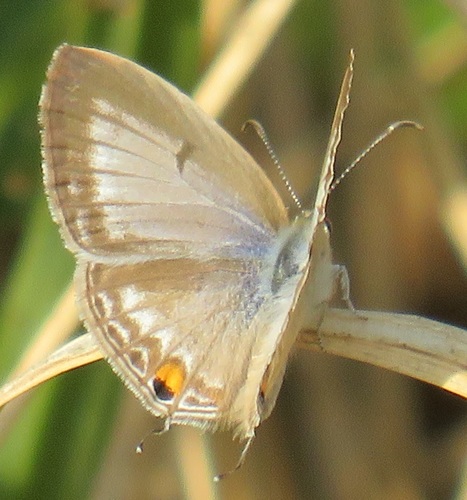
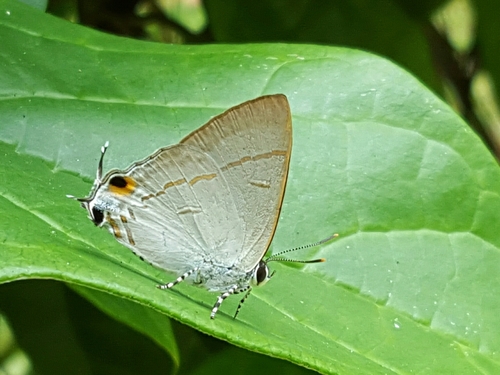
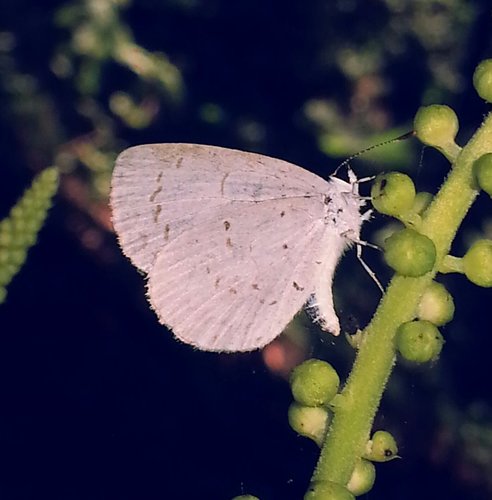
The Appalachian azure (Celastrina neglectamajor) is a butterfly of the gossamer-wing family Lycaenidae. Males have light blue upper wings, with a narrow dark line along the edge of the forewing. Their underwings are chalky white, dotted with small pale dark spots. The edge of the hindwing has a row of dark spots, contained within a faint zigzagging band near the wing's outer margin. Females resemble males, but have broad dark wing borders instead of the male's narrow ones. Adult Appalachian azures have a wingspan of 1.1 to 1.4 inches (2.8 to 3.6 cm), and are the largest azure species in their range. This butterfly is found across the central and southern Appalachian Mountains, ranging from Pennsylvania to Georgia, with a small number of isolated records from Missouri, Kentucky, and Ohio. It inhabits moist, heavily shaded deciduous woodlands and streamsides adjacent to these forests. Males frequently gather in groups near mud puddles alongside these streams. The species is listed as endangered in Connecticut. Adult Appalachian azures lay only one clutch of eggs per generation. Eggs are laid singly on the flower buds of a host plant, though multiple eggs may be placed on the same individual plant. Eggs are pale green. Larvae change color as they develop: early instars are yellowish green, while older larvae become reddish brown. Larvae typically have an incomplete dark band running along their back, and greener younger caterpillars may have pale white markings. Appalachian azure larvae are host specialists: they live on, and feed only on, the flowers of black cohosh (Actaea racemosa). Adult butterflies are active for a few weeks between mid-May and late June. This species is temporally separated from other similar azure species in its range: it flies after the similar spring azure, but before the summer azure. The name neglecta-major was first coined in 1908 by Tutt, who described it as a form of the late spring generation of *Celastrina argiolus pseudargiolus*. In their authoritative monograph on the Lycaenopsis group of Polyommatine genera, Eliot & Kawazoe treated pseudargiolus as a synonym of *ladon* Cramer, 1780. Because of this, the validity of recognizing *neglectamajor* as a full species remains very doubtful. While the species itself is not considered threatened with extinction, its habitat may be threatened by the spread of garlic mustard (Alliaria officinalis). Additionally, black cohosh is harvested from the wild for use as a dietary supplement, and wild harvesting of this medicinal plant can lead to reduced population sizes of the host plant.