About Celastrina argiolus (Linnaeus, 1758)
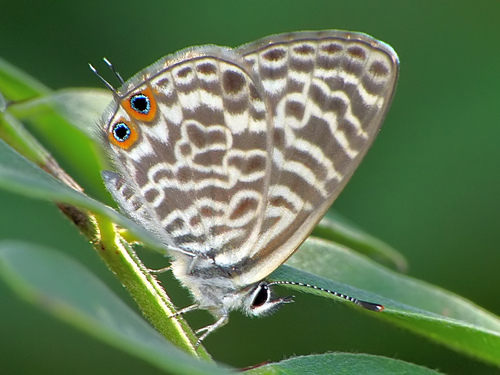
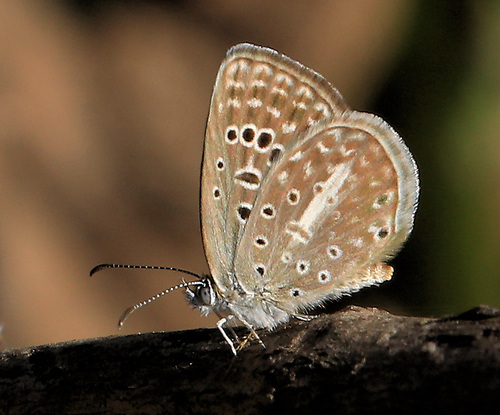
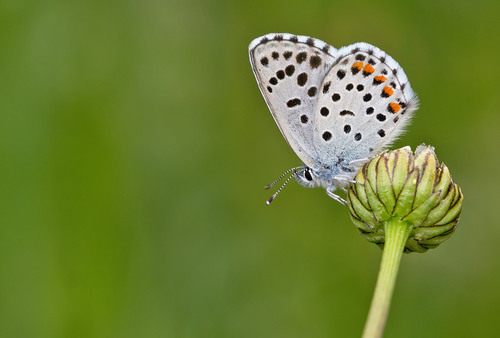
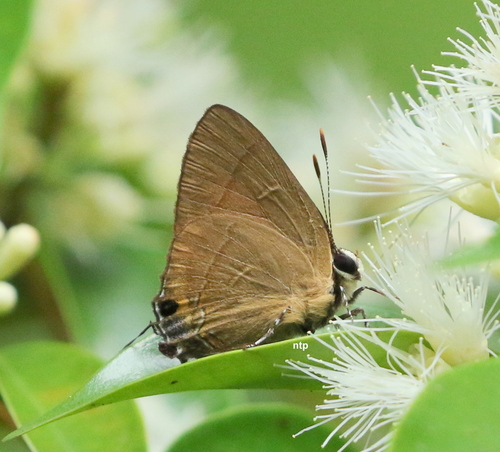
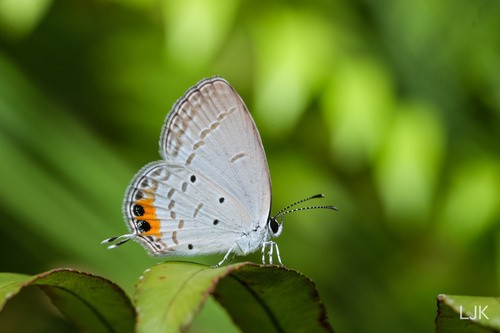
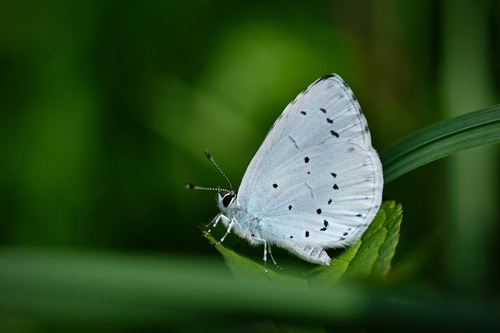
This species, commonly called the holly blue, has the scientific name Celastrain argiolus (Linnaeus, 1758). Adults have pale silver-blue wings marked with pale ivory dots. Seitz's description notes that the upper side of the male's wings is shining violet blue, with only the apical portion of the costal margin finely edged with white. The female has a broad dark border on both wings, and the margin of the hindwing has faint traces of ocelli. The underside of the wings is silver-white, with a row of black dots in the disc (some of which are elongated) and blackish shadowy dots before the margin. Eggs are very flat and whitish. Larvae are green or brown, marked with yellowish white, and bear chain-like (catenulate) stripes on the back. They have a gland on segment 7 that attracts ants, and have brown heads. Larvae feed on ivy, Ilex, Euonymus, Rhamnus, Robinia, Genista, Spartium, Astragalus, Rubus, Erica, Pyrus, and many other plants. In Europe, larvae are usually visited by ants from the genus Lasius, and can be found in June and the autumn. In Europe, the first larval generation feeds mainly on the holly species Ilex aquifolium, while the second generation uses a wider range of food plants. Pupae are mostly fastened to the underside of leaves, and are ochreous with brown spots and markings. Adult butterflies fly in spring, again in July, and occasionally produce a third generation in late August and September. The species is common across its range, particularly frequent at ivy and bramble flowers. It is the national butterfly of Finland. This species ranges across Eurasia. In South Asia, it occurs from Chitral in Pakistan to Kumaon in India.