About Celaenorrhinus leucocera (Kollar, 1848)
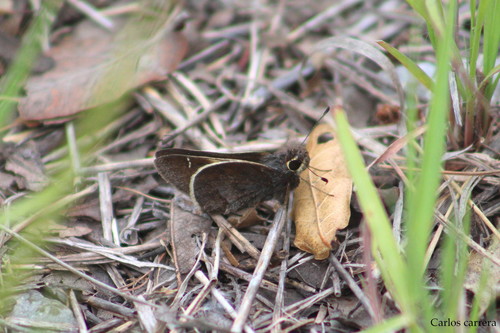
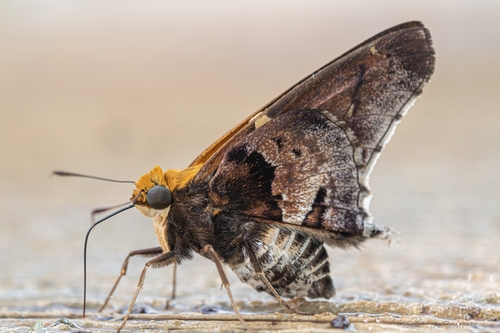
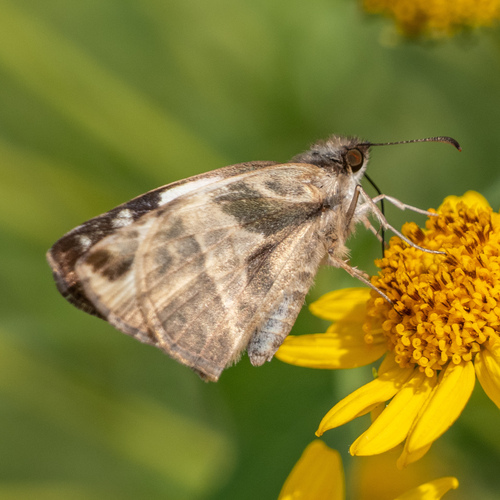
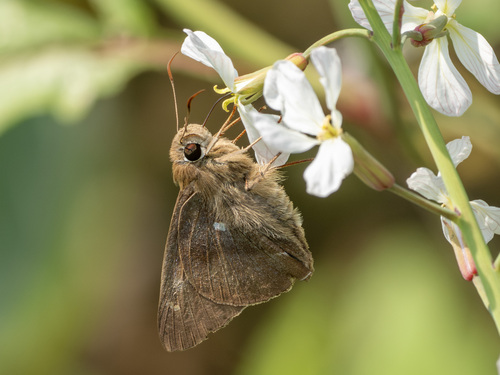
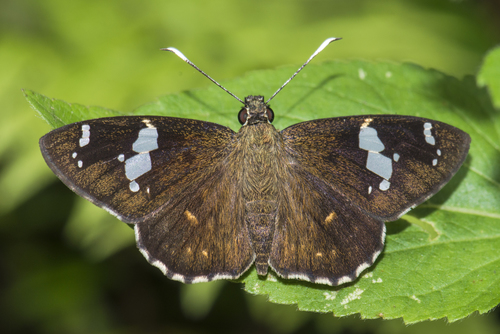
This species is the common spotted flat butterfly, with the scientific name Celaenorrhinus leucocera (Kollar, 1848). The butterfly has a wingspan of 45 to 55 mm. The upper side of its wings is dark brown. Its forewing has a band of more or less connected white, semi-transparent discal spots. Within this band, two spots — one at the end of the cell, and one at position 2 — are rectangular and connected to varying degrees. The forewing apex also has small white spots. The hindwing has a few obscure, opaque yellow spots, and its margins are chequered black and white. Males have plain white antenna shafts, while females have plain brown shafts with white clubs. The species is very variable. A detailed description published by Edward Yerbury Watson in 1891 reads: All wings dark brown; some spots and a minute dot in the middle of the forewing, a small crescent at the apex, all transparent snow-white; on the upper surface of the hindwing four spots, on the under surface a larger number irregularly placed and yellowish, the borders white, interspersed with dusky. Of median size, hindwing rounded at the outer margin, not elongated, the colour of all the wings above and below dark brown. In the middle of the forewing are three snow-white transparent almost quadrangular spots of which the hind one is the smallest, there is also a dot near the middle spot. Near the apex a crescent-shaped spot. On the hindwing several small yellow spots irregularly arranged; four on the upperside more or less obsolete, and seven on the underside almost punctiform, the outer five in a curved row near the outer margin. The fringe of the forewing brown with several whitish spots, on the hindwing alternately yellowish-white and brown. Head and body brown and hairy, the palpi yellowish-white clothed with brown hairs above; two yellow spots at the nape. Club of the antennae snow-white, below brown. This butterfly is distributed across Myanmar, Thailand, western China, Malaysia, and the Indonesian archipelago (Borneo, Sumatra, Java and Bali). In India, it occurs anywhere its preferred forest habitat is found: moist deciduous, semi-evergreen, and secondary evergreen forests with naturally varied herb and shrub vegetation. Its Indian range extends from South India through Maharashtra to Bengal, along the Himalayas from Kashmir to Assam and Arunachal Pradesh (Mishmi Hills), and also includes the Andaman Islands. It can be found from plains level up to 8,000 feet (2,400 m) in the Himalayas, and the species' type locality is the Himalayas. The common spotted flat flies in the wet jungles of the Indian peninsula and the Himalayas. It is a shade-loving insect that rarely leaves the forest, except during early morning, late evening, or overcast conditions. It visits flowers and rests on the undersides of leaves. Its long proboscis allows it to feed from flowers with long tubular corollas. It visits flowers of Impatiens, Asystasia, Blepharis, Peristrophe, Crossandra, and other Acanthaceae shrubs and herbs, which are abundant in the dappled forest edge environments where this butterfly is most often found. The butterfly may occasionally be spotted mud-puddling. When active, it alternates between sun and shade, flying in open patches for a time and resting in shade. It is a wary butterfly that rarely settles on top of bushes, instead resting mostly on leaf undersides, making it difficult to observe well in the field. Its fast, zig-zagging flight also makes it hard to track in the air. It flies fast and low, usually below 6 feet, and aggressively defends its territory from other butterflies. When disturbed, it buzzes in circles before settling near its original perch. Like other species in its group, this species has a characteristic habit of holding its wings spread flat, which is the behavior that gives this group of butterflies their common name.