About Celaenorrhinus ambareesa (Moore, 1865)
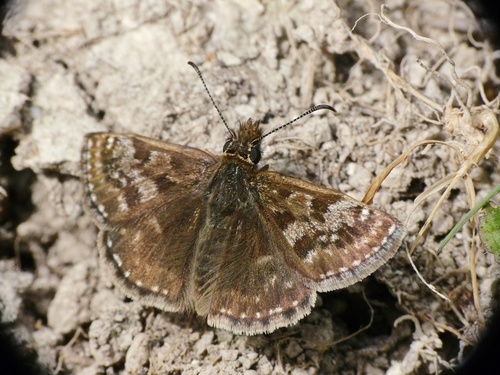
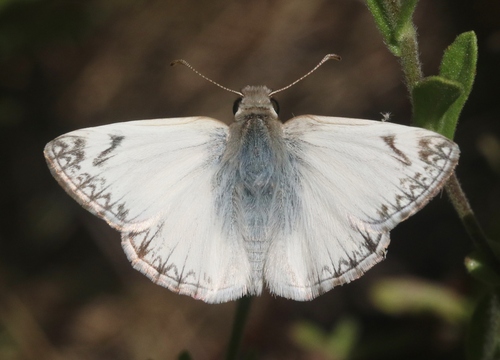
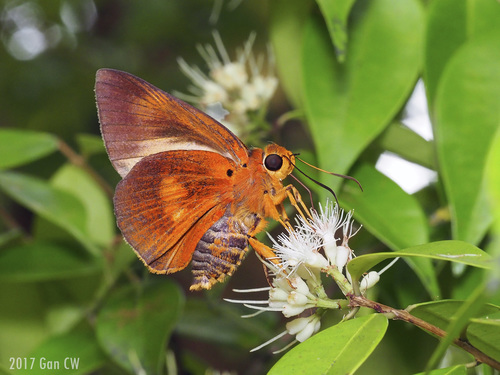
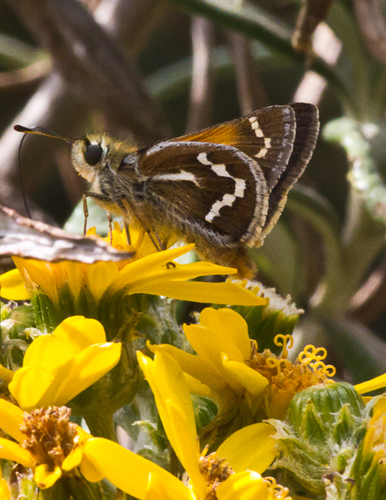
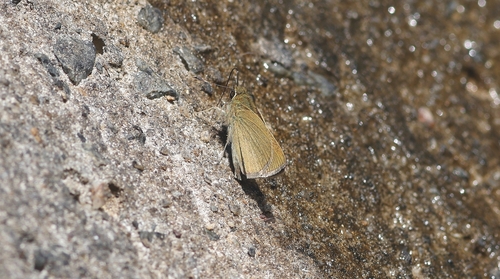
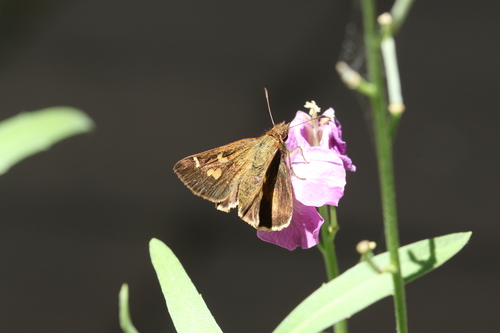
This species, Celaenorrhinus ambareesa (Moore, 1865), commonly known as the Malabar spotted flat, can be distinguished from the common spotted flat by the separated semi-transparent white spots on the upperside of its forewings. It also has distinct rows of pale yellow spots on the hindwing, and its wing fringe (called cilia) is chequered with black and white. Like all spotted flats, it has similar habits and habitats, but it is most often found under boulders and logs that overhang forest streams. In 1891, Edward Yerbury Watson gave the following detailed description: The upperside is dark olive-brown, with the entire surface covered in fine irrorations of delicate yellowish-olive scales. The forewing has an oblique transverse discal series of pale yellowish-white semi-transparent spots: the first spot is large, located within the extremity of the cell, and has an indentation on its outer edge; the second spot is small and positioned some distance beyond the first; the third spot is large and sits beneath the second. Below the third spot are two additional small spots. One-third of the way from the base, beneath the cell, there is a small round spot of the same type. Above the first spot on the costa is a small brighter yellow spot that is not transparent. Before the apex there are five rather large similar spots, with the three upper spots joined together, and the other two also joined to each other. There are one or two lower submarginal orange-coloured spots that are very indistinct. The hindwing has a row of ill-defined orange-coloured submarginal spots, and other even less defined spots closer to the base. The cilia of both wings are broad, marked with alternating brown and yellowish-white sections. The underside is paler and more uniform in color, with the same markings as the upperside. The wingspan of Celaenorrhinus ambareesa ranges from 45 to 55 mm. This butterfly is found across India, with a range extending from South India to Khandesh, Madhya Pradesh, and West Bengal. It is most commonly distributed in moist-deciduous, semi-evergreen, and secondary evergreen forests that have dense herb and shrub layers. It is particularly frequent in areas where canopy openings allow sunlight to reach ground vegetation. This butterfly is most commonly seen during the post-monsoon season. Population numbers are low in the winter and summer months, and increase prior to the monsoon.