About Cecropia peltata L.
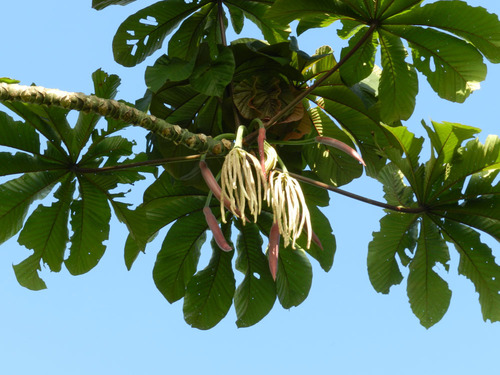
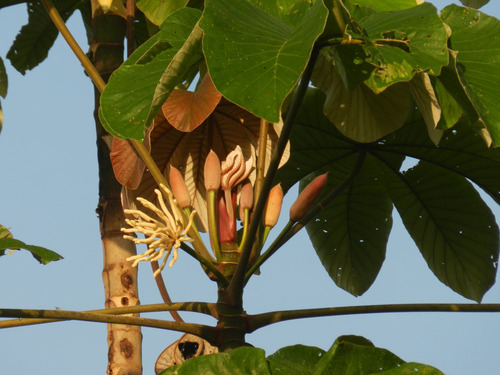
Cecropia peltata L. is a fast-growing tree. It usually reaches 15 metres (49 ft) tall, and may occasionally grow as tall as 25 metres (82 ft). Its leaves are large, ranging from 10–60 centimetres (4–24 in) in both length and width, and most commonly measure around 20 × 20 centimetres (8 in). Leaves are palmately divided into 7 to 11 lobes, most often 8 to 10 lobes. The upper leaf surfaces are covered in scales, while the lower leaf surfaces are covered in minute hairs mixed with longer hairs. Leaf petioles are typically 20–50 centimetres (8–20 in) long. Branches are green and covered with short, stiff hairs. Like other species in the genus Cecropia, C. peltata is dioecious, meaning individual plants are either male or female. Male flowers are 1–1.5 millimetres (0.039–0.059 in) long, and grow in spikes 10–60 centimetres (4–24 in) long. The entire male inflorescence is enclosed in a spathe, which splits open and falls off once the anthers reach maturity. Female flowers grow in paired spikes 3–5 centimetres (1.2–2.0 in) long. Its fruit is an achene around 2 millimetres (0.079 in) long, enclosed in a fleshy jacket that develops from the perianth. The native distribution of Cecropia peltata extends from southern Mexico through Central America to northern South America, Guyana, Trinidad and Tobago, and Jamaica. It has been introduced to regions of Africa, Asia, and the Pacific. The Invasive Species Specialist Group has listed this species as one of the one hundred worst invasive alien species. In Cameroon, C. peltata has been reported to replace the native African tree Musanga cecropioides, its very close ecological analogue, along major roads.