About Cecropia pachystachya Trécul
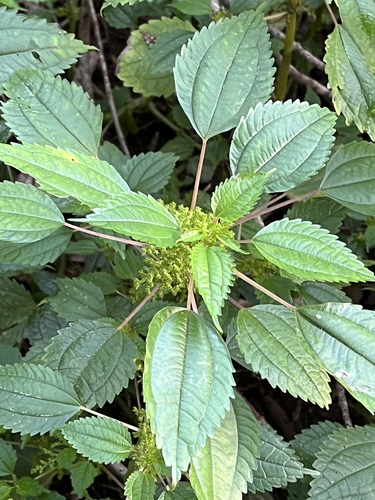
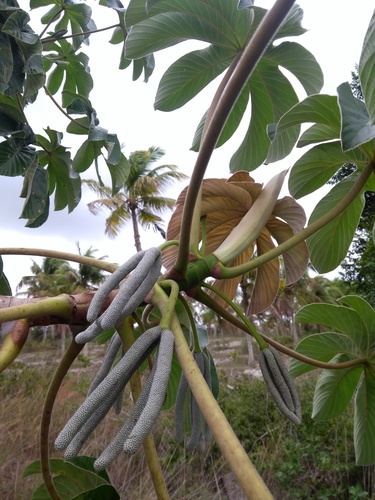
Cecropia pachystachya Trécul is a small evergreen tree that reaches around 6 meters (20 feet) in height, with a trunk diameter between 15 and 25 centimeters (6 to 10 inches). It has an open growth structure, with just a few branches that fork at obtuse angles, and often grows into a parasol-like shape. Its twigs are hollow and filled with mucilage; both twigs and branches leak mucilaginous sap when damaged. Its large leaves are nearly circular, deeply split into nine to ten lobes separated by 2 to 3 centimeter gaps. The upper leaf surface is rough, while the lower surface is felted with pale-colored hairs. This is a dioecious species, meaning male and female flowers grow on separate individual trees. C. pachystachya shares a mutualistic relationship with ants of the genus Azteca, which protect the tree from herbivores. To support this relationship, the tree provides nourishment for the ants: this includes Müllerian bodies, glandular areas on leaf stalks that produce oily secretions, nectar from female flowers, and pearl bodies on leaf surfaces. This tree is mostly found in Brazil, Bolivia, Paraguay, and Argentina, growing at altitudes up to around 1,000 meters (3,300 feet). It grows near the edges of humid primary forests, as well as in forest clearings and secondary growth forests. It is a pioneering, fast-growing but short-lived species that sprouts easily in recently cleared forest areas. Locally, C. pachystachya is harvested for its lightweight timber, which is used to make toys, boxes, pencils, and plywood. Fibers from its bark are used to make sails, and its mucilage can be used to produce glue. The tree has many uses in traditional medicine and contains multiple bioactive compounds. Its leaves have anti-inflammatory properties, and laboratory testing has found they have antibacterial activity against a range of bacteria. Leaves and other parts of the tree are used to treat respiratory complaints, oedema, kidney disorders, diabetes, Parkinson's disease, high blood pressure, and a variety of other conditions.