About Ceanothus prostratus Benth.
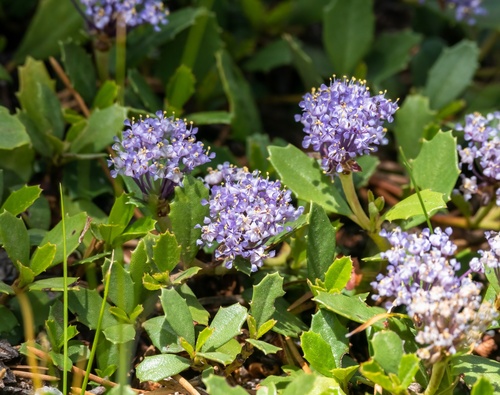
Ceanothus prostratus Benth. is a decumbent, mat-forming evergreen shrub. It usually grows less than 0.3 meters (1 foot) tall, and spreads laterally to reach up to 3 meters (10 feet) across. Its leaves are arranged oppositely, are generally oval in shape, and have 3 to 9 sharp teeth along their margins. It produces umbel-like inflorescences holding blue, purple, or lavender flowers, which bloom between April and June. Its fruit is small and rounded, with horned lobes.
This species occurs across the Pacific Northwest of North America, growing through Washington, Oregon, western Idaho, western Nevada, and extending south into northern California. The southern edge of its natural range is the central Sierra Nevada mountains. It is also native to many other Pacific Northwest mountain ranges within its range, including the Klamath Mountains, Siskiyou Mountains, Cascade Range, and Warner Mountains. It grows in the understory of mixed conifer forests, from foothills to subalpine areas. It also grows in open flats and ridges in low chaparral regions, as well as in dry interior forest ecosystems. Its elevation range spans from 270 to 2700 meters above sea level.
Ceanothus prostratus belongs to Ceanothus subgenus Cerastes, a clade of Ceanothus generally defined by traits including opposite leaves, persistent corky stipules, and horned fruits; the name "Cerastes" comes from the Greek word meaning "having horns". This subgenus likely began diversifying at the start of the Pliocene, approximately 6 million years ago, when cool, dry conditions coincided with the uplift of the Coast Ranges to create new, diverse habitats. According to a 2011 phylogenetic study, the closest relatives of C. prostratus within subgenus Cerastes are Ceanothus pinetorum and Ceanothus purpureus.
C. prostratus is a common nitrogen-fixing shrub, and is often found growing alongside Purshia tridentata. Together, the nitrogen these two species add to soil may account for 10 to 60 percent of the annual nitrogen input to their ecosystems. It is one of only two known host plants for the parasitic dodder Cuscuta jepsonii, alongside Ceanothus diversifolius; Cuscuta jepsonii was thought to be extinct until recently, and may still survive parasitizing C. prostratus in northern California. This species is one of the regional plants that colonizes logged areas, forming brushfields after timber harvest when more light reaches the ground. It occurs in plant communities alongside many other species, including Abies magnifica, Arctostaphylos nevadensis, Arctostaphylos patula, Pinus albicaulis, Pinus contorta, Pinus jeffreyi, Pinus ponderosa, Quercus vaccinifolia, and Tsuga mertensiana.