About Ceanothus cyaneus Eastw.
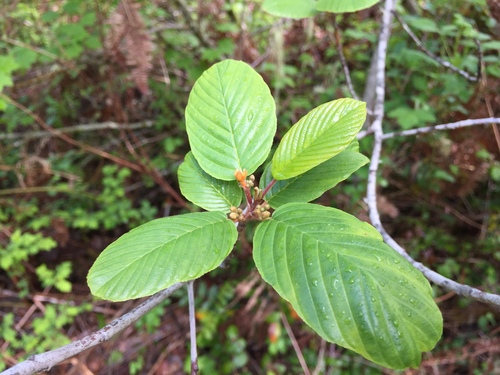
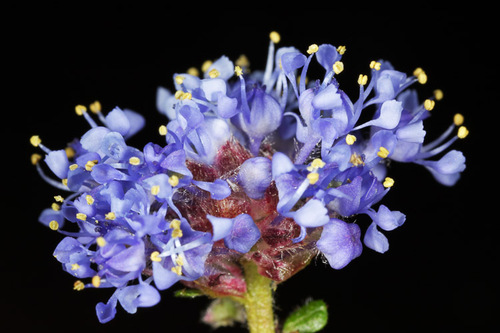
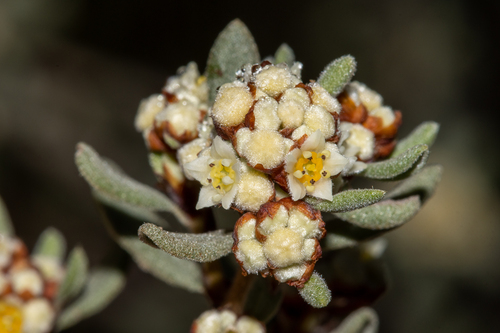
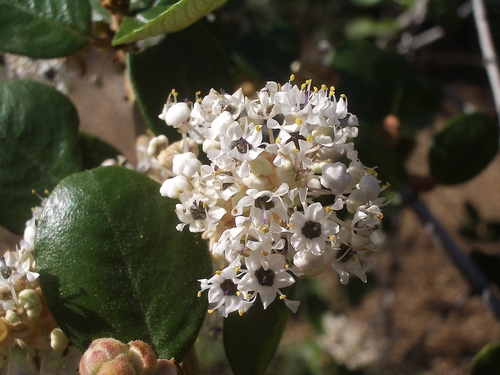
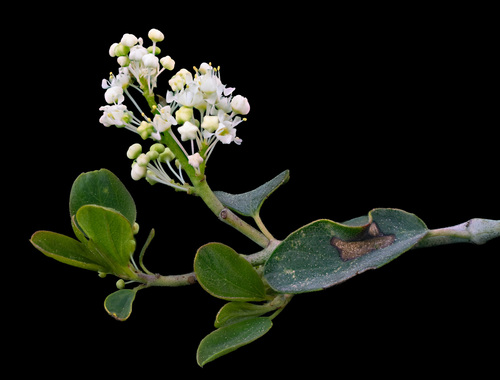
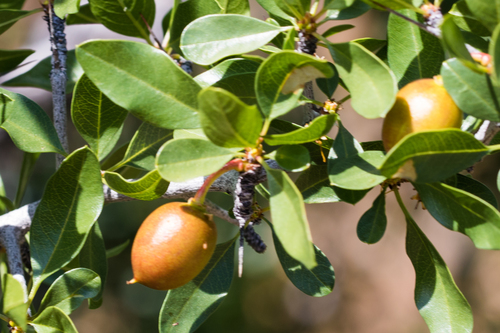
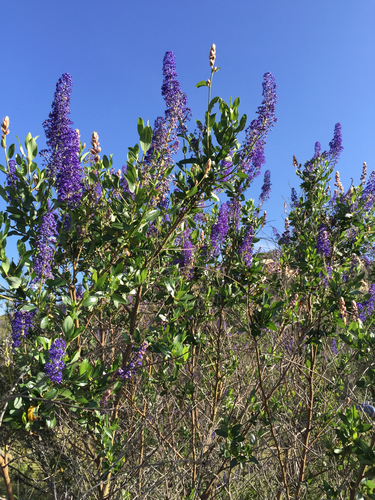
Ceanothus cyaneus Eastw. is an open, evergreen shrub that grows less than 3 m tall. Its stems grow ascending to erect, bearing flexible, light-green twigs. Twigs of this species are papillate (covered in small protuberances called papillae) and not thornlike, and they are flexible rather than rigid like the twigs of Ceanothus leucodermis. Leaves are alternately arranged, with scale-like stipules. The leaf petiole measures 2 to 6 mm long; the leaf blade is 14 to 45 mm long and 15 to 20 mm wide, with a length less than twice its width. Leaves range in shape from ovate to elliptic. The upper leaf surface is dark green, smooth, and hairless, while the lower leaf surface is pale green with hairy veins. Leaf margins are more or less serrate, with 23 to 58 teeth; unlike Ceanothus tomentosus, this species lacks conspicuous black glands on the teeth along its leaf margin. Compared to the local species Ceanothus tomentosus, this plant also has larger leaves. Additionally, its leaves are almost glabrous (hairless), which distinguishes them from the leaves of both Ceanothus tomentosus and Ceanothus oliganthus. The inflorescence is 5 to 30 cm long, and holds deep or bright blue flowers; these flowers are very distinctive for their brilliant blue color. Plants flower from April to June. The fruit produced is 3 to 5 mm wide. This species is distributed across part of San Diego County, California, United States, and has one recorded historical occurrence in Baja California, Mexico. In San Diego County, it grows in inland chaparral on the Peninsular Range foothills near the communities of Lakeside and Crest. It occurs in dense, nearly impenetrable chaparral growing on igneous rock and rocky, coarse sandy loam soils. In Baja California, only a single historical collection is known, from near Cerro Coronel between Tijuana and La Mision. This species was introduced to cultivation in California by Theodore Payne. For cultivation, it requires good drainage, must be kept dry during summer, and is not tolerant of frost.