About Ceanothus cuneatus var. rigidus (Nutt.) Hoover
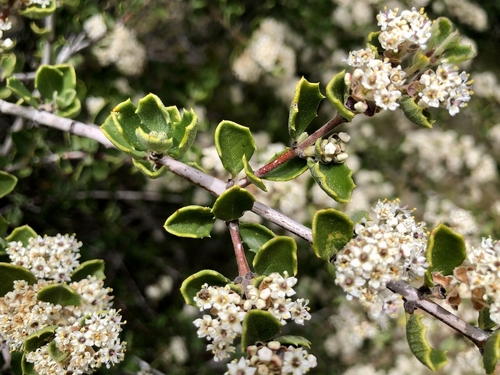
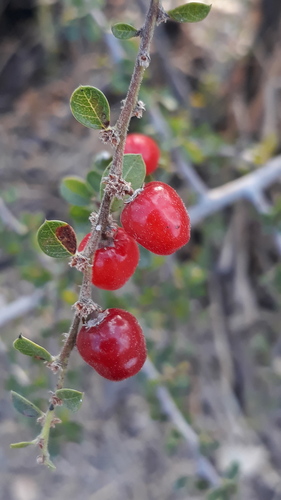
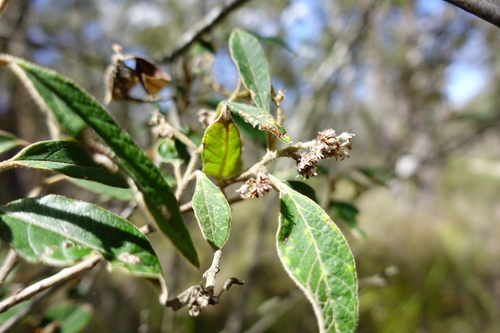
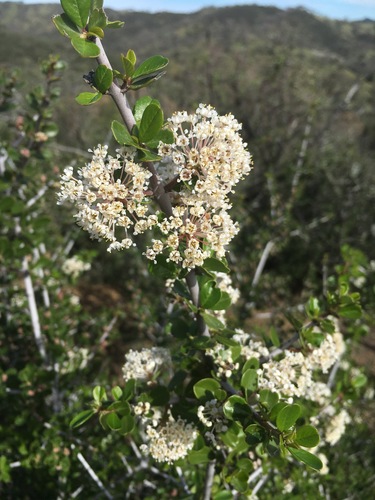
Ceanothus cuneatus is a spreading, rounded to sprawling bush that grows up to 3 meters (9.8 ft) tall. Its evergreen leaves are stiff, somewhat tough, and may have slight teeth along the edges. The bush blooms abundantly, producing short, thick-stalked racemes that hold rounded clusters of tiny flowers; each individual flower is about half a centimeter wide. The flowers are fragrant, white, and sometimes have a strong blue or lavender tint. The fruit is a round, horned capsule around half a centimeter wide, which contains three shiny dark seeds. The seeds are dispersed when the capsule explodes, propelling them some distance away. Harvester ants have been observed collecting these seeds. Seeds can lie dormant for a long time, as fire is required for them to germinate. This plant can vary in appearance because it hybridizes easily with similar related species. While the whole species has a wide distribution across its range, certain individual varieties are restricted to small geographic areas. For example, the variety treated here, var. rigidus (Monterey ceanothus), is found only between the southern edge of the San Francisco Bay Area and San Luis Obispo County. The species Ceanothus cuneatus is native to Oregon, California, and northern Baja California, where it grows in a number of habitats, most commonly chaparral. Ecologically, it acts as a larval host for the California hairstreak, California tortoiseshell, ceanothus silkmoth, echo blue, hedgerow hairstreak, Pacuvius duskywing, western green hairstreak, and white-streaked saturnia moth.