About Catopsis berteroniana (Schult. & Schult.f.) Mez
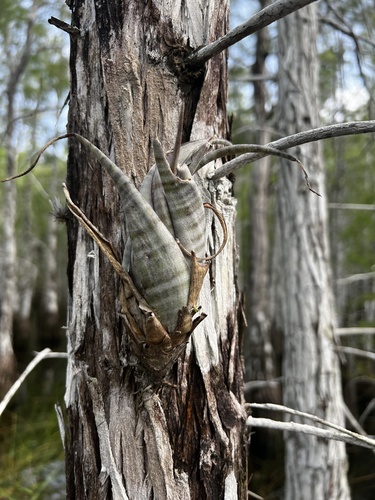
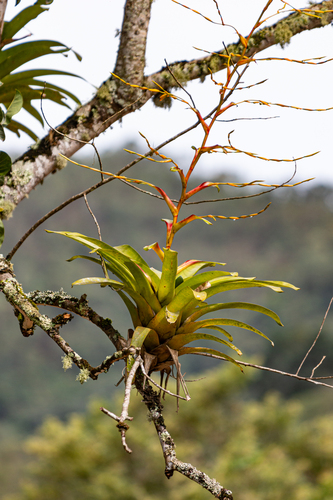
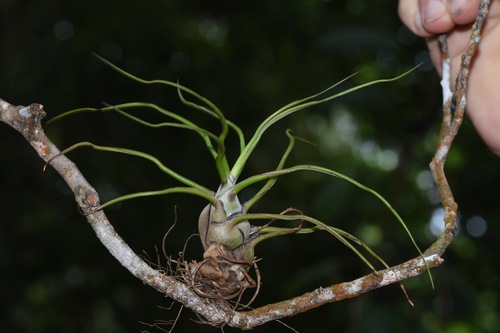
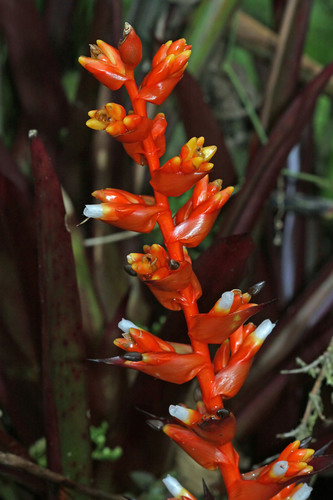
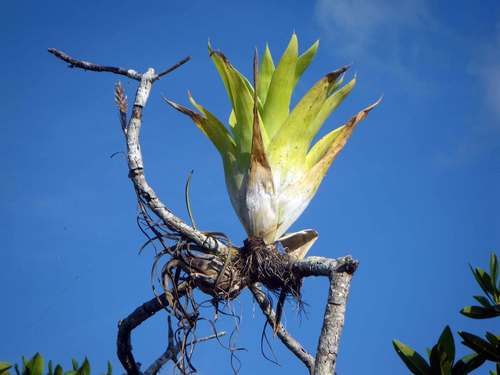
Catopsis berteroniana is an epiphytic plant that produces elongate, erect leaves. These overlapping leaves form the tube-like structures typical of many tank bromeliads. Rainwater collects in these tubes to form water pools called phytotelmata, aqueous reservoirs that hold large amounts of nutrients for the plant to absorb. The phytotelmata medium is slightly acidic, very close to neutral; algae living in these bromeliad phytotelmata indicate the pH of Catopsis berteroniana’s phytotelmata is 6.8. This species has sessile glands on its epidermis that it uses to absorb nutrients. Other carnivorous plant species, such as Cephalotus follicularis, use these same glands to secrete enzymes that break down detritus and trap prey. However, C. berteroniana does not produce enzymes, so it breaks down organic materials through other methods. A notable trait on the leaves of Catopsis berteroniana is a white powder released from the leaf surface; this powder is very slippery and reflects ultraviolet light. Catopsis berteroniana is distributed across the neotropics, ranging from southern Florida to southern Brazil. It grows above tree canopies, where it is exposed to high levels of sunlight. As documented by Fish in 1976, growing above tree canopies allows Catopsis berteroniana to avoid direct competition with other species, because it does not need to obtain nutrients from soil or tree canopies. In southern Florida’s Everglades National Park, these plants have been found growing at the apex of red mangroves, and in areas with limited shade. A key reason this species is restricted to the neotropics is that its phytotelmata require humid environments. The plant cannot generate enough energy to offset the excessive evaporation that occurs in very dry climates.