About Catocala promissa (Denis & Schiffermüller), 1775
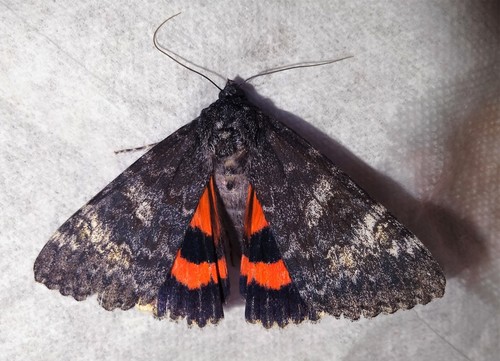
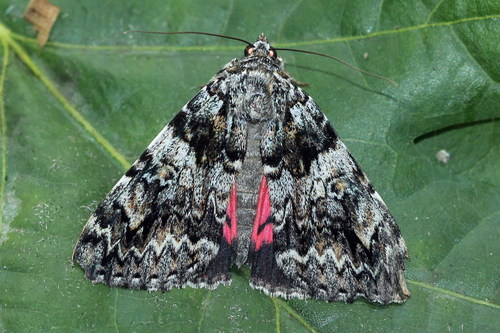
This species, Catocala promissa (Denis & Schiffermüller), 1775, is smaller than Catocala sponsa. For the forewing, the ground color is white dusted with pale and dark grey; the costal edge between the lines is white. A black basal line and a black streak run from the base below the cell. The inner line is double and black, forming a bluntly rounded projection in the submedian interval, and it is generally accompanied by a diffuse black shade that forms a band. The space between the outer and subterminal lines is filled with dark color. The subterminal line is pale grey, zigzag, and black-edged on the outside. The median space is generally paler grey, particularly on the costa before the reniform spot and before the outer line. The reniform spot has a blackish center and a pale grey ring, and sits within a diffuse dark median shade; the spot below it is generally pale grey and distinctly outlined with black. The hindwing is crimson, with a broad black terminal border and a narrow sinuous median band that does not reach the inner margin. The sinuosity of this band varies greatly, and is reportedly greatest in specimens from Britain and Hungary. Cases where the band actually reaches the inner margin are very rare, and limited only to dark-suffused females. Several named aberrations are recorded: ab. ochracea Oberth., found in Valais and Silesia, has pale yellow ochreous hindwings instead of red; ab. rosea Tutt has a red dorsum matching the color of the hindwings, as first recorded by Guenee; in ab. obsoleta Schultz, the black bands of the hindwing have diffuse edges rather than the usual clear sharp markings, and blend into the red ground color, giving the entire wing a dark appearance. The larva is bluish grey or greenish grey, with irregularly shaped black marks of varying intensity on the dorsum and sides. Its tubercles are fine and white. The hump on segment 9 is surrounded by black, with a white center; the hump on segment 12 bears two strong points. The head is yellow with black marks. The venter has a row of black spots, and the lateral filamentary processes are very strongly developed. The wingspan of this species is 60–65 mm.