About Catocala piatrix Grote, 1864
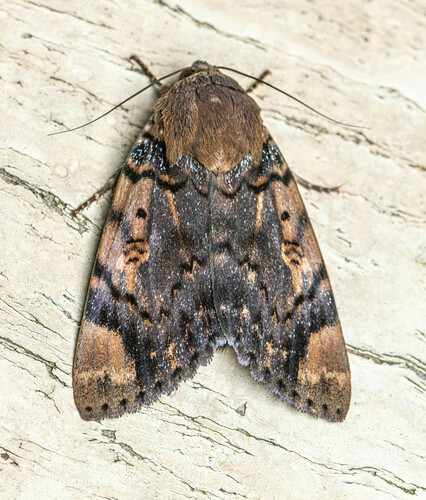
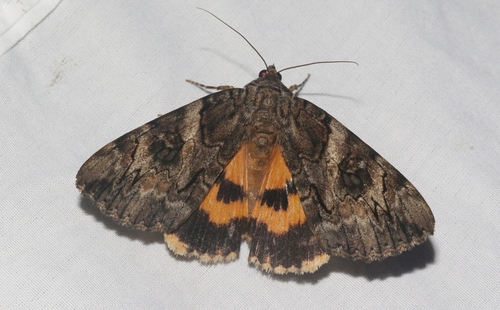
Catocala piatrix, commonly known as the penitent underwing, is a species of moth native to North America. It was first formally described by Augustus Radcliffe Grote in 1864. This species is classified in the subfamily Catocalinae: it is placed in the family Noctuidae when Noctuidae is broadly defined, and in the family Erebidae when Noctuidae is defined more strictly. Within Catocalinae, it belongs to tribe Catocalini, and to subtribe Catocalina when Noctuidae is circumscribed widely. Adult penitent underwings have a wingspan of approximately 70 to 80 mm. Their forewings are dark brownish gray, darkest at the base, with an oblique lighter band that stretches from the midwing to the leading edge near the wing base. Their hindwings are yellow orange, with non-prominent dark hairs at the base and two concentric black bands. The yellow zone between these black bands is wide and has a relatively smooth edge; the outer edge of the hindwings is light yellow, with a number of black bars extending outward from the outer black band. Consistent with other hickory-feeding Catocala species, both the foreleg and hindleg tibiae of Catocala piatrix are spiny, and each tarsus bears four irregular rows of spines. The flight period of adult moths runs from July to November, varying by location. The species' larvae feed on the foliage of ash, butternut, hickory, pecan, persimmon, and walnut trees. Two subspecies of Catocala piatrix are recognized: the nominate Catocala piatrix piatrix Grote, 1864 and Catocala piatrix dionyza H. Edwards, 1884. The nominate subspecies occurs in the eastern United States, while subspecies C. p. dionyza is found in Arizona.