About Catocala nymphagoga Esper, 1787
Scientific name: Catocala nymphagoga Esper, 1787
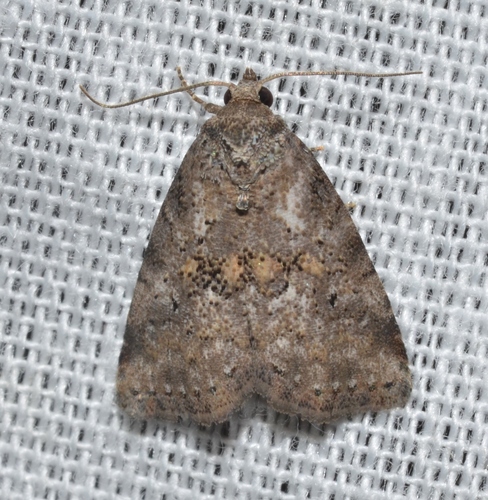
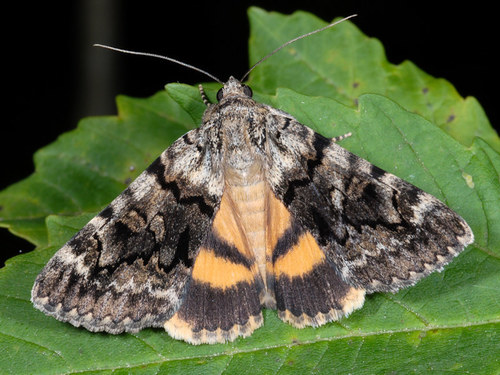
Technical description and variation: The forewing is grey, more or less entirely suffused with blackish brown. The basal area (or at least its lower half), a costal patch beyond the inner line, a streak from the costa before the outer line, and the submarginal line itself remain pale. The inner and outer lines are velvety black, distinct, and sometimes doubled. The inner line is oblique, and dentate inwards on the veins; the outer line is biangulate externally (at vein 5, it forms a deep inwards sinus, its end below the reniform is pale, and has an inward angle on vein 1. The reniform is indistinct, obscured by the brown median shade, with a dark centre and outline. The subterminal line is waved, distinct, with darker dentate edges.
The hindwing is yellow, with a broad black terminal border that contains a small yellow spot at the apex and an inward sinus in the submedian interval. The median band is narrow and straight, angled acutely or squarely on the submedian fold; the base of the wing is often darkened with olive fuscous.
The darkest specimens, with forewings almost entirely unicolorous black brown, form the aberration anthracita Thierry-Mieg. The form tmolia Led. has pale grey forewings; the black median band of the hindwing is not angled, but is obscure, and acutely zigzag between the veins, which are black. The reniform stigma is followed by a dark grey cloud, and contains a pale yellowish lunule at its centre. The hindwing is dull red, with a narrow, nearly straight black median band, shortly angled inwards on the submedian fold. The terminal border is black, broad at the apex, evenly curved on its inner edge, and has a deep sinus on the submedian interval.
Specimens from Uralsk are all smaller, uniform brownish grey, without any black and white shading. The lines are faint and slight. The black streak from the base above and below the submedian fold is well marked. The hindwing has a curved, thinner median band; the terminal border is nearly or quite interrupted across the submedian interval. These are currently recognized as subspecies detrita subsp. nov., now treated as the full species Catocala detrita Warren, 1913.
The larva is extremely like that of C. electa. It is pale yellowish grey, finely dotted with black, with two obscure dorsal streaks. It has a small yellowish hump on segment 9; the hump on segment 12 is slight and bifid. The head is small, grey with dark marks and two small reddish protuberances. The wingspan of this species is 35–43 millimetres (1.4–1.7 in).