About Catocala nupta Linnaeus, 1767
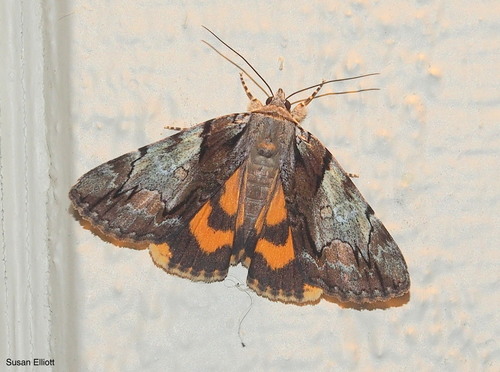
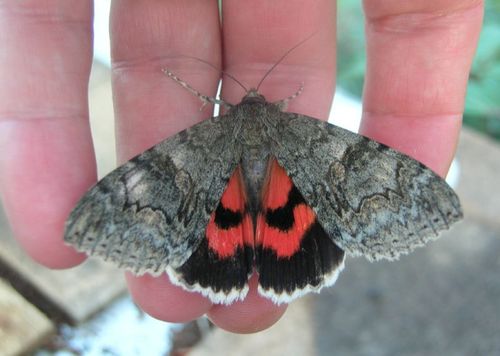
This entry covers technical description and variation for Catocala nupta Linnaeus, 1767, also called C. nupta L. The forewing is pale grey dusted with darker grey, sometimes with dark grey banded suffusion, and occasionally has a yellowish tinge. In some individuals, the cell area before the reniform spot merges with the spot below the reniform, and a strip along the outer line—above the middle before the line and below the middle beyond the line—are all whitish. The inner and outer lines are double, colored black and grey; the outer line is less oblique below the middle, forms two more noticeable angles on each side of vein 2, with the lower angle being double, and is then deeply indented along vein 1. The median shade is usually distinct and extends straight outwards beyond the reniform spot, which has a thick black central lunule, a curved black inner edge, and a tridentate outer edge. The subterminal line is pale and dark grey, and the paler inner portion is sometimes whitish. The hindwing is crimson with a central black band that bends at vein 5, and a thick black terminal border, whose inner edge is wavy toward the abdominal margin. In the form concubina Hbn., the red of the hindwing is brighter, the black median band is more developed (broader throughout and extending to the inner margin), the lines of the forewing are blacker, and pale areas are generally more developed. The subspecies nuptialis Stgr., found in Tibet (Ili, Issyk-kul, Ala Tau) and the Altai Mountains, has a paler forewing with more vivid markings; the submarginal line is white and sharply edged with black. The subspecies obscurata Oberth., from Amurland and Askold Island, is a much darker form than typical European specimens, though dark specimens also occur at multiple localities in Europe. The aberration coerulescens Cockerell, named from a single individual collected in Essex, has blue rather than red hindwings. The aberration brunnescens ab. nov., represented by 3 rather small males captured near London, has dark olive brown hindwings. In the aberration languescens ab. nov., the hindwing is yellowish white with a faint pink flush; one specimen of this aberration, without a locality label, is held in the Felder Collection, and a similar specimen is recorded by Mr. Tutt in British Noctuae, Volume IV, page 50. Like other species with red hindwings, nupta has an aberration where red is replaced by yellow: ab. flava Schultz. Intermediate forms exist where red is only partially changed to yellow, or yellow occurs on just one hindwing. In aberration mutilata Schultz, the black central band of the hindwing is shortened and becomes obsolete a little below the costa. Aberration fida Schultz differs from typical specimens in having a prominent dentated white line strongly edged with black between the subterminal line and the termen; this specimen originated from Silesia. In aberration dilutior Schultz, the overall ground color is paler; it is either brownish yellow with dark markings that are only slightly darker, or whitish grey with a faint yellow tint. Aberration alterata ab. nov. (= ab. 6 Hmps.) has the black bands of the hindwing changed to grey. Aberration rubridens ab. nov. has the red ground color of the hindwing extending out along veins 2 and 1 as sharp wedge-shaped teeth, almost interrupting the black median band, which swells between the teeth into a large horseshoe-shaped blotch; the only known specimen held at the Tring Museum unfortunately lacks a locality label. A strange, probably accidental aberration from Munich, figured as ab. confusa Oberth., has the entire forewing uniformly blurred dark grey, with the inner and outer lines and reniform stigma darker but diffuse on a slightly paler median area. The median band of the hindwing is strongly curved, its outer edge is diffuse, and its lower end runs narrowly upward toward the inner margin and the base. The black terminal border projects baseward as long narrow teeth along the veins, with the red ground color extending upward between these teeth. The larva is pale or dark grey; it can only be distinguished from the larva of Catocala elocata by the absence of dark dorsal and lateral bands, which are replaced by lines in C. nupta.