About Catocala neogama J.E.Smith, 1797
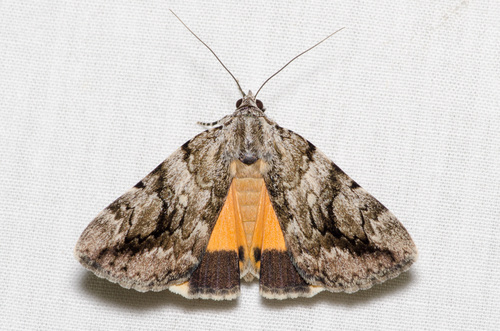
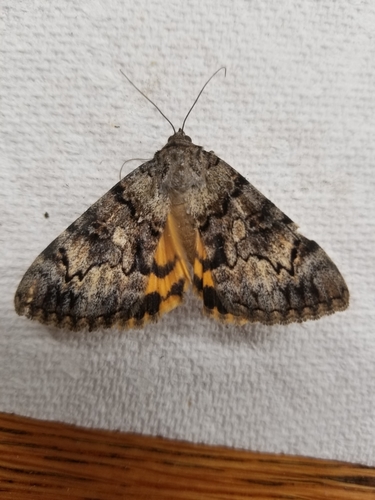
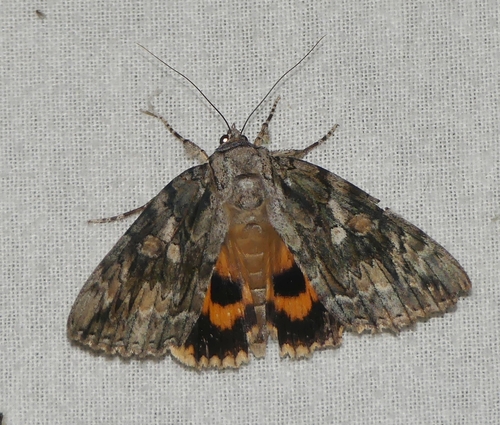
This species, Catocala neogama, has a wingspan of 70–85 mm. The subspecies C. n. euphemia is distinctly larger, with a wingspan around 90 mm. The upper surface of the forewings is brownish gray. They are evenly dark from base to tip, or slightly darker in the center. Their appearance varies geographically: aridland populations are somewhat paler and browner, while eastern individuals are darker gray marked with brown, matching Gloger's rule. The upper surface of the hindwings is conspicuously colored in various shades of orange, with roughly concentric black markings. The basal area of the hindwings has a dense covering of thin dark hairs that extends along the dorsum, making this area appear more brownish or reddish. A black band runs through the center of the hindwing from the leading edge almost to the trailing edge. A similar but wider band runs close to and parallel with the termen, from the apex to the tornus. The border between the black bands and the fairly narrow orange area between them is not even, and features deep, irregular scallops. The outer rim of the hindwing is a lighter yellow than the rest of the wing. Along the wing veins, the outer black band extends to the termen as faint blackish stripes. The undersides of the wings are pale yellowish orange with black bands. As is typical for North American hickory/walnut-feeding Catocala, both the foreleg and hindleg tibiae of this species are spiny, and each tarsus has four rows of irregular spines. The old wife underwing, Catocala palaeogama, is most easily distinguished by its thickly hairy hindwing bases on both the lower and upper surfaces, which form a fuzzy black patch on the upperwings. It also has a less scalloped, more angular orange and black border on the hindwing upperside, and it is distinctly smaller with little to no overlap in wingspan with Catocala neogama. Adults of the nominate subspecies are found from June to October, while C. n. euphemia adults are active from July to August. Caterpillars of this species feed on Juglandeae trees from the genera Juglans (walnut trees, including the butternut tree Juglans cinerea) and Carya (hickories). The westernmost population of Catocala neogama apparently does not feed on Carya, which is rare or absent in their range. Their diet seems effectively limited to the Arizona black walnut (Juglans major), and possibly the Texas black walnut (Juglans microcarpa) and their hybrids.