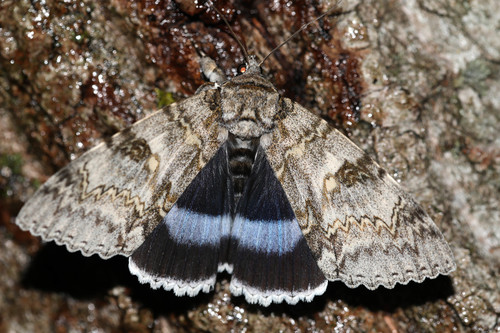
About Catocala fraxini Linnaeus, 1758
Technical description and variation: The forewing is whitish ochreous, dusted with pale or dark grey, and sometimes has a yellow tinge. The inner and outer lines are blackish, dentate, and double; the median and subterminal lines are also blackish and dentate. The reniform stigma has a black centre and black outline; beneath it sits a pale yellowish diamond-shaped spot outlined in dark (this dark marking is the basis for the aberration name moerens). The hindwing is blackish, with a broad blue postmedian band. Aberration moerens Fuchs has the forewing more or less strongly suffused all over with blackish grey, which obscures the markings. In contrast, the form gaudens Stgr. from Central Asia is very pale, with most of the black scaling no longer visible. In aberration contigua Schultz, the pale spot below the reniform stigma is elongated outwards to touch the outer line; this spot and the outer line itself are often strongly yellow-tinged, which is especially noticeable in specimens with a dark ground colour. Aberration angustata Schultz is distinguished by the narrow width of the blue band on the hindwing. Aberration maculata Kusenov has a white mark at the lower angle of the cell on the hindwing. Schultz also recorded a case of albinism affecting the forewings, where all grey scales changed to white, the black lines became brownish yellow, and the hindwings remained unchanged. Distribution: The species' range covers almost all of central and northern Europe, as well as parts of southern Europe. It is largely absent from Portugal, Mediterranean islands except Corsica, Greece, northern Scotland, northern Scandinavia, and southern Russia. Its range extends across the Palearctic to northern Turkey, Siberia, the Russian Far East, Korea, and Japan. The common name "Clifden nonpareil" comes from the location of the first British records, which were at the Cliveden estate in Berkshire in the 18th century; "nonpareil" means "without equal" in French. This moth became extinct as a breeding species in Great Britain by the 1960s, following post-war changes to forestry. For example, the larval foodplants aspen and poplar were cleared in Orlestone Forest, Kent to make way for conifers. For decades after its extinction as a breeding species, it was only a rare migrant from Europe, with just single sightings recorded in some years. Larvae have since been found in Sussex, and sightings in 2018 indicate the species has spread to the Midlands and Wales.