About Catocala electa Vieweg, 1790
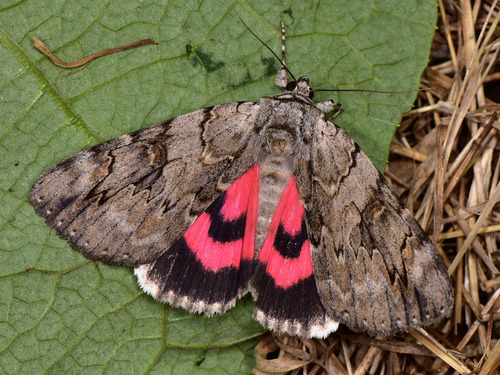
This is the technical description and variation of Catocala electa Vieweg, 1790 (synonymized as C. electa Bkh. = pacta Esp. nec L.). The forewing is pale grey dusted with darker pigment; a dark grey band, often tinted brownish, occurs beyond the outer line and along the termen. The inner and outer lines are double, alternately black and dark grey, and less distinctly marked below the middle. The inner line is dentate inwards, while the outer line is dentate outwards with a pair of more prominent teeth on each fold; the outer line runs inwards above vein 2 and forms an oblong pale blotch below the reniform stigma. The reniform stigma is inwardly black and curved, outwardly dentate, contains a brownish lunule, and is outlined, especially externally, with pale grey. The submarginal line is dentate, in alternating light and dark grey, and connected by an oblique dark shade from below the apex. The median shade is distinct at the costa, and diffuse beyond the reniform stigma. The hindwing is crimson, with a sinuous median band ending on vein 1 and a broad black marginal border; the fringe is white. The aberration ab. meridionalis Spul. (= suffusa Gillm.), found in more southern localities, is larger and more heavily shaded with dark grey brown, especially along the inner margin. The aberration ab. nigra Spul. is a rare form with blackish brown forewings; its lines are whitish or yellowish, and the forewing fringe, base, and thorax may be either pale or blackish. The aberration ab. lugdunensis Mill. (= flava Spul.) has the red color of the hindwing changed to yellow. The aberration ab. excellens Schultz has wholly black hindwings, where the two typical black bands only appear deeper black. Chinese and Japanese specimens belong to the subspecies subsp. zalmunna Btlr.; they are larger than European specimens, have less distinct markings in the lower half of the forewing, and a more conspicuously brown lunule in the reniform stigma. Their ground colour ranges from the common pale silvery grey through ochreous grey to the dark grey of specimens from Gensan and the Amur region, for which Schultz proposes the name subsp. subtristis Schultz. Similar dark aberrations to subsp. subtristis occasionally occur even among European specimens. The larva ranges in colour from pale or dark yellowish grey to yellowish brown, and is finely dotted with black. The tubercles are yellow; the hump on segment 9 is bright yellow with a black outline, while the hump on segment 12 is bifid and brownish yellow. The spiracles are white with dark rings; the lateral fringes of filaments are whitish. The wingspan of Catocala electa is 65–80 mm.