About Catocala amica Hübner, 1818
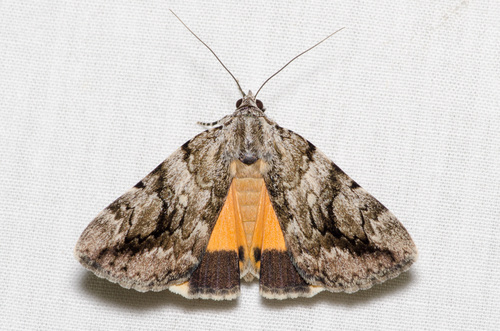
Description and ecology: The wingspan of adult Catocala amica moths measures 35–40 mm. Adults can generally be easily recognized by their cryptically patterned forewings, a yellow base color on their hindwings, and a distinct black pattern on the hindwings. This black pattern is made up of a black band along the outer edge of the hindwing, except for the hindmost part where a separate black dot is located. Forewing color varies considerably between individuals, but similar species that live sympatrically with Catocala amica usually have an extra black band running across the center of their hindwings. Unlike many (though not all) other underwing moth species, all of the tibiae of Catocala amica are completely spineless. Adults are active in flight from June to September, with the timing varying by location, and they are often attracted to UV light at night. Caterpillars of this species feed on oak species from the genus Quercus, specifically including bur oak (Quercus macrocarpa), chestnut oak (Quercus prinus), dwarf chinkapin oak (Quercus prinoides), post oak (Quercus stellata), swamp white oak (Quercus bicolor), and white oak (Quercus alba) from section Quercus, plus bear oak (Quercus ilicifolia), eastern black oak (Quercus velutina), northern red oak (Quercus rubra), and scarlet oak (Quercus coccinea) from section Lobatae.