About Catharus occidentalis P.L.Sclater, 1859
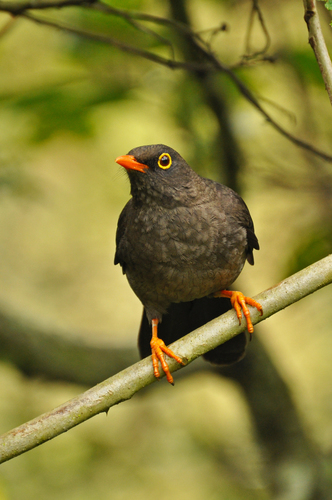
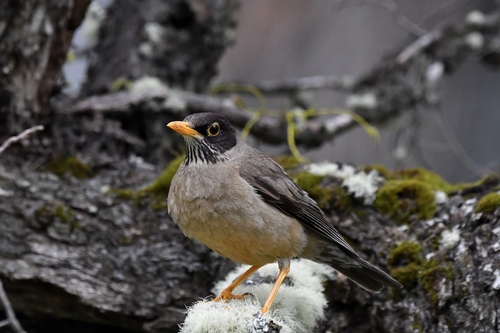
The russet nightingale‑thrush (Catharus occidentalis P.L.Sclater, 1859) measures 15.5 to 18 cm (6.1 to 7.1 in) in length and weighs 22 to 37 g (0.78 to 1.3 oz). Males and females have identical plumage. Adult nominate subspecies C. o. occidentalis have deep russet brown crowns and napes, with light olive brown or buffy olive faces. Their upperparts are overall more olivaceous russet brown than the crown, while the uppertail coverts and tail are more rufescent than the back. Their wings mostly match the back's color, with buffy coloring on the base of the flight feathers' inner webs. The chin and throat are buffy whitish, grayish white, or pale buff, and the throat usually bears faint grayish brown or olive streaks. The breast is pale buffy olive with indistinct darker streaks or spots, and the flanks are pale grayish olive. Immature birds have russet or rufescent brown crowns and upperparts marked with light tawny streaks or spots. Their underparts are mostly pale buffy, with olive or olive brown feather tips. Subspecies C. o. olivascens has olive brown upperparts with no russet coloring. Its throat and breast are a deeper buff than the nominate subspecies, with heavier gray streaks, and the center of its belly is pure white. C. o. lambi is similar to olivascens, but is slightly darker, has a redder brown crown, and smaller markings on the breast. C. o. fulvescens has a lighter rufous crown, lighter and more fulvous upperparts, and much paler underparts than the nominate subspecies. All subspecies have a brown iris, a dark brown or blackish upper mandible, a yellowish lower mandible tipped with dusky, and pale pink legs and feet. The russet nightingale‑thrush has a disjunct distribution, with each subspecies occupying its own range: C. o. olivascens is found in northwestern Mexico, from southeastern Sonora and western Chihuahua south to northern Sinaloa and northwestern Durango; C. o. lambi is found in central Mexico, from Durango south to northwestern Jalisco, and from southeastern Coahuila south to northwestern Puebla; C. o. fulvescens is found in southwestern Mexico, from southern Jalisco east to Puebla and south to Guerrero; and C. o. occidentalis is found in southern Mexico, in western Guerrero and Oaxaca. This species inhabits montane evergreen forest, pine-oak forest, and oak forest in the subtropical and lower temperate zones, and occurs at elevations between 1,500 and 3,700 m (4,900 and 12,100 ft).