About Catharus guttatus (Pallas, 1811)
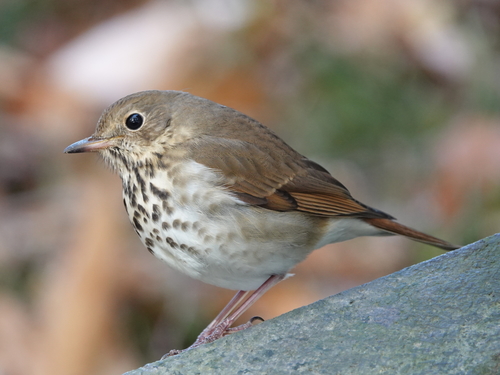
Catharus guttatus, commonly known as the hermit thrush, has the following physical description: This species measures 15 to 18 cm (5.9 to 7.1 in) in total length, has a wingspan of 25 to 30 cm (9.8 to 11.8 in), and weighs 18 to 37 g (0.63 to 1.31 oz). Standard body measurements include a wing chord of 7.8 to 11.1 cm (3.1 to 4.4 in), a bill length of 1.6 to 1.9 cm (0.63 to 0.75 in), and a tarsus length of 2.7 to 3.3 cm (1.1 to 1.3 in). Compared to other North American Catharus thrushes, this species is more compact and stockier, with relatively longer wings. It displays the white-dark-white underwing pattern that is characteristic of all Catharus thrushes. Adult hermit thrushes have mainly brown upperparts and reddish tails. Their underparts are white with dark spots on the breast, and grey or brownish flanks. They have pink legs and a distinct white eye ring. Populations in the eastern part of the species' range have more olive-brown upperparts, while populations in the west have more grey-brown upperparts. Hermit thrushes breed in coniferous or mixed woodland habitats across Canada, southern Alaska, and the northeastern and western United States. They are considered very rare vagrants to western Europe and northeast Asia. Most hermit thrushes migrate to wintering grounds in the southern United States, extending south to Central America, though some individuals stay year-round in northern coastal U.S. states and southern Ontario. Identifying North American spotted thrushes is simplified because the hermit thrush is the only spotted thrush that is normally found in North America during winter.