About Catharus fuscescens (Stephens, 1817)
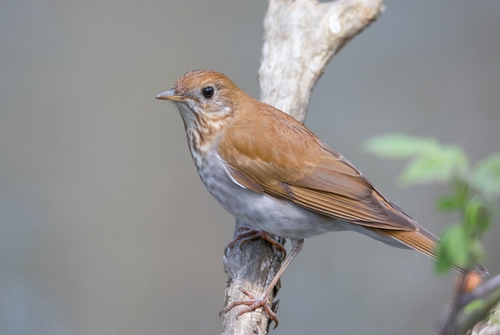
Catharus fuscescens, commonly called the veery, measures 16 to 19.5 cm (6.3 to 7.7 in) in length. It has a mass of 26 to 39 g (0.92 to 1.38 oz), and may reach an exceptional maximum mass of 54 g (1.9 oz). Its average wingspan is 28.5 cm (11.2 in); individual wings measure 8.9 to 10.4 cm (3.5 to 4.1 in), the bill measures 1.2 to 1.9 cm (0.47 to 0.75 in), and the tarsus measures 2.7 to 3.25 cm (1.06 to 1.28 in). Like other members of the Catharus thrush genus, the veery has a characteristic under-wing stripe. Adult veeries have mainly light brown upperparts. Their underparts are white, with a light tawny breast marked by faint brownish spots. They have pink legs and a poorly defined eye ring. Individuals in the eastern part of the species' breeding range have more cinnamon-colored upperparts, while western breeding individuals are more olive-brown. In the eastern part of the range, veeries are easily distinguished by their coloration, but distinguishing western veeries from other Catharus thrushes is more difficult. This bird produces a breezy, downward-spiraling, flute-like song, most often given from a low, concealed perch. Its most common call is a harsh, descending vee-er, which is the source of the bird's common name. Other recorded calls include a chuckle, a sharp low "wuck", and a slow wee-u. Studies have found that veeries decrease the rate and duration of their singing when exposed to playback of barred owl calls, possibly to lower their chance of predation. The veery's breeding habitat is humid deciduous forest across southern Canada and the northern United States. Suitable breeding habitat includes dense growth and a dense understory located close to a water source such as a stream. Veeries are migratory birds that winter in eastern South America; their winter range may cover the entire Amazon basin, Mérida state in Venezuela, the headwaters of the Orinoco River, and São Paulo state in Brazil. Stopover sites used during migration by multiple veeries originating from Delaware include the Gulf of Mexico coast, the coasts of the Carolinas, Cuba, Jamaica, Colombia, and Venezuela. Veeries are very rare vagrants to western Europe.