About Catharus fuscater (Lafresnaye, 1845)
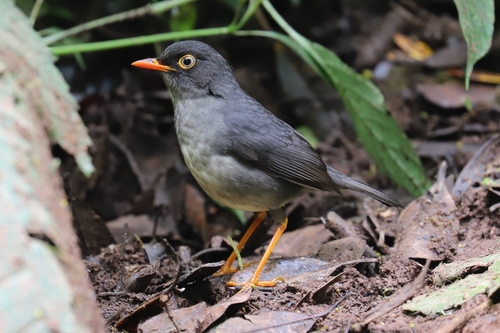
The slaty-backed nightingale-thrush, with scientific name Catharus fuscater (Lafresnaye, 1845), measures 17 to 18 cm (6.7 to 7.1 in) in length. Specimens collected from Ecuador and Colombia weigh 30.5 to 38 g (1.1 to 1.3 oz). Males and females have identical plumage. Adult individuals of the nominate subspecies C. f. fuscater have a dark slate gray head, a bright orange to yellowish orange eye-ring, and a white to gray throat. Their upperparts are dark slate gray, and their underparts are mostly dark slate gray. The center of their breast and belly have varying amounts of mixed-in white, and the white sometimes carries a yellowish tint. Other subspecies differ from the nominate and from each other as follows: C. f. hellmayri has more blackish upperparts than the nominate, a mouse gray throat, and darker underparts. C. f. mirabilis is essentially identical to the nominate. C. f. sanctaemartae has upperparts matching the nominate but less white on the underparts. The limited number of available specimens of C. f. opertaneus are browner than the nominate. C. f. caniceps has somewhat lighter upperparts than the nominate and less white on the underparts. C. f. mentalis has a brownish wash on the upperparts and darker underparts than the nominate. All subspecies usually have a white iris, though the iris is sometimes cinnamon brown, and all have bright orange bills. The slaty-backed nightingale-thrush has a disjunct distribution. Different sources vary widely in their descriptions of the ranges of the subspecies, in part due to additional subspecies recognized by Clements. The International Ornithological Congress (IOC) assigns subspecies ranges as follows: C. f. hellmayri is found in Costa Rica and western Panama; C. f. mirabilis is found in eastern Panama; C. f. sanctaemartae is found in northern Colombia; C. f. fuscater is found in eastern Panama, from Colombia to western Ecuador, and western Venezuela; C. f. opertaneus is found in western Colombia; C. f. caniceps is found in northwestern and central Peru; C. f. mentalis is found in southeastern Peru and northwestern Bolivia. Clements provides more detailed range descriptions with several differences, and includes four additional subspecies. The Clements subspecies and ranges are: C. f. hellmayri in the mountains of Costa Rica and the Chiriquí and Veruagas provinces of western Panama; C. f. mirabilis on Cerro Pirre and its vicinity in eastern Panama; C. f. arcanus from Serranía de Majé eastward to Cerro Tacarcuna in eastern Panama; C. f. sanctaemartae in the Sierra Nevada de Santa Marta in northern Colombia; C. f. fuscater in Serranía del Perijá on the Colombia-Venezuela border and along the eastern Andes of Venezuela southward to Bogotá, Colombia; C. f. opertaneus in the western Andes of Colombia from Antioquia southward to Tolima, and the east-central Andes in Napo, Ecuador; C. f. tenebris in the Rio Chinchipe watershed of southeastern Ecuador and northern Peru; C. f. berlepschi in the western Andes of Ecuador from Carchi to El Oro; C. f. caniceps from El Oro to northwestern Peru; C. f. nebulus on the eastern Andean slope of Peru from the Amazonas to Cuzco departments; C. f. mentalis in the Andes from Puno Department in Peru into La Paz Department in Bolivia. Field guides for the birds of multiple countries generally match the range descriptions of these two taxonomic systems, and some provide even greater detail. In Costa Rica, the species occurs on both the Caribbean and Pacific slopes of the country's central mountain ranges. In the Venezuelan Andes, its range is detailed from southern Táchira north through Mérida, northwestern Barinas, Trujillo, and southeastern Lara. The species is recorded in all three ranges of the Colombian Andes, though not along the full length of these ranges. In Ecuador, it occurs in a continuous band along the western Andean slope and occurs sporadically on the eastern slope. In the Peruvian Andes, it occurs only in the northwest on the western slope, but it occurs along almost the entire length of the country on the eastern slope. One source states that the slaty-backed nightingale-thrush lives in montane evergreen forest in the subtropical zone, at elevations between 800 and 2,300 m (2,600 and 7,500 ft). Another source notes that it inhabits the dense undergrowth of moist and humid forests of the subtropical and lower montane zones between 600 and 3,250 m (2,000 and 10,700 ft). A field guide adds that the species favors locations near streams. Within individual countries, it occurs at elevations of 800 to 1,800 m (2,600 to 5,900 ft) in Costa Rica, 1,500 to 2,900 m (4,900 to 9,500 ft) in Venezuela and Peru, 800 to 2,800 m (2,600 to 9,200 ft) in Colombia, and mostly 1,200 to 2,600 m (3,900 to 8,500 ft) in Ecuador.