About Catharus frantzii Cabanis, 1861
The scientific name of the ruddy-capped nightingale-thrush is Catharus frantzii Cabanis, 1861.
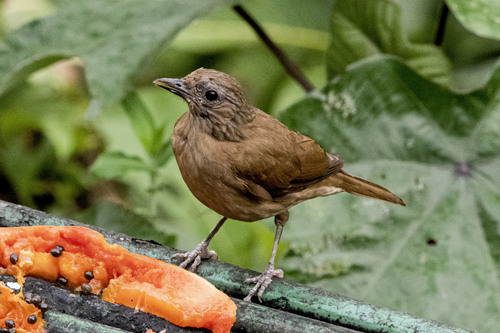
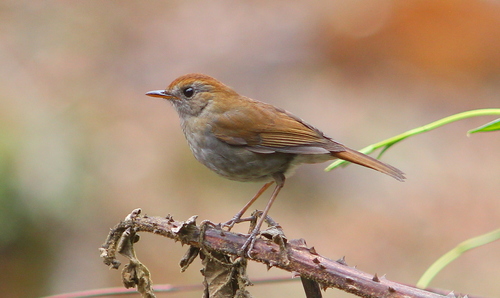
Description: The ruddy-capped nightingale-thrush measures about 15 to 18 cm (5.9 to 7.1 in) long and weighs approximately 30 g (1.1 oz). Males and females have identical plumage. Adults of the nominate subspecies C. f. frantzii have a rich rufous-brown to russet crown, and a grayish face that sometimes carries an olive tinge. Their back and rump are brownish olive with a russet wash, and their uppertail coverts are deep rufous-brown. Their wings are mostly the same color as the back and rump, but the flight feathers have silvery white undersides. Their tail is deep rufous-brown. Their chin and throat are whitish with dark flecks. Their breast is pale gray with an olive tinge and dark flecks. Their belly, vent, and undertail coverts are whitish.
Juveniles have a dark olive-brown to reddish brown crown and upperparts. Their face is sootier than that of adults. Their breast is olive with darker feather tips. Their lower breast, belly, and flanks are whitish with olive or olive-brown bars.
Other subspecies of the ruddy-capped nightingale-thrush differ from the nominate subspecies and from each other as follows: C. f. omiltemensis has duller upperparts and whiter underparts than the nominate; C. f. nelsoni resembles the nominate but has a brownish wash on the breast; C. f. chiapensis resembles omiltemensis but has a slightly darker tail and uppertail coverts; C. f. alticola has grayer underparts than the nominate; C. f. juancitonis is smaller than the nominate and has a more reddish crown; C. f. waldroni resembles juancitonis but is smaller and has less brown on the breast; C. f. wetmorei has a paler crown, breast, and back, and less gray underparts than the nominate.
All subspecies have a dark iris, a blackish maxilla, an orange-yellow mandible, and pale pink to grayish or brownish pink legs and feet.
Distribution and habitat: The ruddy-capped nightingale-thrush has a disjunct distribution. Each subspecies is found in a distinct range: C. f. omiltemensis occurs in southwestern Mexico; C. f. nelsoni occurs in south-central Mexico; C. f. chiapensis occurs from southern Mexico into western Guatemala; C. f. alticola ranges from Chiapas in southern Mexico south through Guatemala into El Salvador; C. f. juancitonis occurs in El Salvador and Honduras; C. f. waldroni occurs in northern Nicaragua; C. f. frantzii occurs in Costa Rica; C. f. wetmorei occurs in Chiriquí Province of western Panama.
The ruddy-capped nightingale-thrush primarily inhabits montane evergreen cloudforest and pine-oak forest in the subtropical and lower temperate zones. It also lives in nearby secondary forest, thickets, and modified habitats such as clearings. Across its entire range, it mostly occurs at elevations between 1,200 and 3,100 m (3,900 and 10,200 ft). It is found between 1,500 and 3,500 m (4,900 and 11,500 ft) in Mexico, between 1,500 and 3,050 m (4,900 and 10,000 ft) in northern Central America, between 1,500 and 2,500 m (4,900 and 8,200 ft) in Costa Rica, and between 1,200 and 2,400 m (3,900 and 7,900 ft) in Panama.